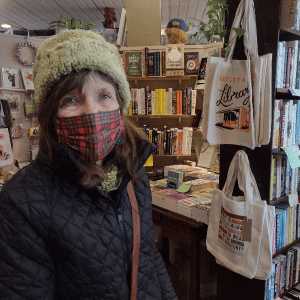
Volumes Bookcafe, Wicker Park in Chicago, 1373 N. Milwaukee Ave.
By Beth Uznis Johnson
Who remembers that glorious day in May 2020 when 28 authors from around the country released a reenactment of the library dance scene from The Breakfast Club to the song “We Are Not Alone”? I’d seen their faces on book jackets, Twitter, and a few in person at writing events over the years. Amid the isolation of the pandemic, to get this inside peek at their homes and dance styles was beyond thrilling.

Not only did they dance their asses off, they did it in support of Volumes Bookcafe, an independent bookstore in the Wicker Park neighborhood of Chicago. The video was conceived by Chicago author, Rebecca Makkai, who is also the artistic director of the nonprofit literary organization, StoryStudio Chicago. At the time, I was a Michigan-based writer without a neighborhood bookstore. To see the literary community rally behind a beloved bookseller touched me deeply.
It was a great day on literary Twitter. I watched the dance video at least 10 times.

It made me long to move back to Chicago, a vibrant literary community, with many indie bookstores sprinkled around its more than 200 neighborhoods. Flash forward to 2023 and I did move back. With the launch of my debut novel, Coming Clean from Regal House Publishing, slated for January 2024, I vowed to never live in a community without a bookstore again.
“Volumes, on Milwaukee Avenue,” my friend Claude said without hesitation, when I asked for the best bookstore around my new condo in West Town. I scrambled to open my maps app and couldn’t believe my luck: Volumes Bookcafe of Wicker Park was only 0.7 mile away. A 15-minute walk! A 7-minute bike ride! A 4-minute drive if I could talk my husband into dropping me off.
Even better, I can pick up Claude on the way. She’s only 0.2 mile away.
Come to find out my kickass neighborhood bookstore has an amazing neighborhood story. When a new landlord upped the rent (during the pandemic, no less), forcing Volumes to temporarily close their doors in Wicker Park, the neighbors rallied. They found a great location, crowdsourced funds to BUY the store space, and partnered with owners, sisters Rebecca and Kimberly George, to open a new, forever location at 1373 N. Milwaukee Ave.
With the community deeply invested in the store and the days of pandemic isolation in the past, Volumes has everything a reader (or writer) could ever need, starting with the heavenly new-book smell and knowledgeable staff who love and care about literature. Foot traffic in the store has returned and the in-person event schedule is back and growing.

Rebecca, who spends the bulk of her time at the Wicker Park location, gives me her take on the book business, including:
- 1. Physical books are a much-needed escape in a world where people spend far too much time on screens.
- 2. Community bookstores are a reflection of the community itself and, in Wicker Park, that means a focus on fiction, science fiction, kids’ books, and nonfiction on topics of social justice, popular culture, and true crime.
Volumes offers handwritten recommendations for books in all categories around the store, from its section featuring Chicago authors to carefully curated literary fiction, best-selling graphic novels, mysteries, memoirs, and on and on. The notes include quick plot summaries, staff picks, who liked the book and why. There are also novelty items and gifts for readers (and writers) like literary-themed mugs, t-shirts, bookends, and socks. There are cozy nooks for reading, a picnic table for discussions, and tables for work-oriented patrons. There’s a café with baked goods, coffee drinks, teas, and other refreshments.

I sit with Rebecca while she checks out a customer, a man she obviously knows based on their rapport. He’s finally decided to use the gift card he’s been hanging onto, selecting a cookbook with glossy photographs.
“You’ll have to bring in some of the dishes you make and we’ll sample them,” Rebecca jokes. The customer laughs and pauses, seeming to seriously consider it. We chat for a few minutes and I wonder if there is a way to ask them to call me for this sampling party; I like to eat, especially when someone else cooks, and I’m new in the neighborhood and looking for friends.
After the customer leaves with his book, Rebecca shares there’s a story behind the joke: some amazing cookbooks were released in the spring of 2020, the early days of the pandemic, and a local mom and her kids had—indeed—continued to visit Volumes with samples of baked goods they’d made together.

launch of The Comback Summer
The café, Rebecca says, is especially nice to have during author readings and other events at the store. She tells me about a literary-themed private event the night before: a husband planned a surprise party for his wife that included an 8-course meal with themes from her favorite classic books. She was one of Volume’s first Wicker Park customers. She was really surprised.
Rebecca also tells me about a children’s book, The Story of Ukraine: An Anthem of Glory and Freedom, that Volumes took to local schools for student readings over the course of a week. The Wicker Park neighborhood is next to Ukrainian Village, where many Ukrainian families live. One child, from a refuge family, read the book to his mom three times and insisted on sleeping with it. Other classmates got enthused and decided to do an action project to support Ukraine.
My new Chicago neighborhood suddenly feels distinctly more intimate than the bookstore-less Michigan suburb I’d lived for more than 20 years. Strange how a big city can feel quaint; a suburb can feel vast and never ending. During the brief years a Border’s Books opened and closed, I never heard friendly chats between shop owners and customers.

Rebecca says Volumes loves to support new authors and local writers. She encourages me to attend some events at the store and recommends an upcoming Ali Brady launch, a summer beach read titled The Comeback Summer. So, I go. It turns out the author is the writing team of Chicago writer, Allison Hammer, and her friend, Bradleigh Godfrey. I’m amazed at the turnout: the bookstore is packed! It turns out the authors are members of the Women’s Fiction Writers Association, which has a large Chicago contingency. The WFWA members have come in droves to support the book.
As a proud member of the WFWA since its 2020 pandemic write-ins, I feel the warmth of the Chicago literary community like an embrace. How lucky to be here for the launch of Coming Clean. How amazing that Volumes Bookcafe is my neighborhood bookseller. How exciting to have Volumes in Wicker Park hosting my launch event on January 13, 2024.
How lucky I donated so many books before I moved and can now refill my shelves with all the great new literature. Volumes will see a lot of me in the years to come.
Visit Volumes for the launch of Coming Clean by Beth Uznis Johnson: Saturday, January 13, 2023, at 6:30 p.m. at Volumes Bookcafe, 1373 N. Milwaukee Ave, Chicago, IL 60622 Website: www.volumesbooks.com ; Instagram: @volumesbooks ; Facebook: @volumesbooks ; X: @volumesbooks

Beth Uznis Johnson’s short fiction and essays have appeared in Massachusetts Review, Broad Street, Cincinnati Review, Story Quarterly, Mississippi Review, Southwest Review, “The Best American Essays,” and elsewhere. She lives and writes in Chicago. Coming Clean is her first novel. www.bethujohnson.com