• Skip to primary navigation
  • Skip to main content
  • Skip to footer

Regal House Publishing

Advancing Finely Crafted Literature

  • Home
  • About Us
    • The Origin Narrative of an Indie Press
    • The Regal Mandate
    • Our Imprints
    • The Regal House Initiative
    • Regal House Publishing Staff
    • Our Professional Affiliations
    • RHP’s Climate Commitment
    • Helen Keller Intl
    • RHP Summer Scholars Program
    • Contact & FAQ
    • Blog
  • Authors
    • Our Authors
      • Regal House Authors & Poets
      • Fitzroy Books Authors & Poets
      • Pact Press Authors & Poets
    • Forthcoming Publications
    • Sour Mash: RHP’s Southern Literature Series
    • Fugere Books: RHP’s Novella Series
    • Regal House Reading Series
    • Author Resources
  • Submissions
  • Marketing & Distribution
    • Our Distribution and Printing Partners
    • Subsidiary Rights
    • For Retailers
    • Events
    • A Conspiracy of Lemurs Podcast
  • Contests
    • The Fugere Book Prize for Finely Crafted Novellas
    • The Petrichor Prize for Finely Crafted Fiction
    • The W.S. Porter Prize for Short Story Collections
    • Past Contests
      • The Kraken Book Prize for Middle-Grade Fiction
      • The Acheven Book Prize for Young Adult Fiction
    • The Terry J. Cox Poetry Award
  • SHOP

BookBound

Gramercy Books and the Quiet Revival of Columbus Bookselling

June 2, 2026 2 Comments

By Scott Lambridis

I lived in Columbus for six years after college. It’s where I met my wife, where I played in a band, and where I first got serious about writing—serious enough to start a small press of my own. So when I spoke with Linda Kass of Gramercy Books, I assumed I knew what kind of bookstore landscape she was describing. 

I didn’t.

Gramercy opened in 2016, long after I’d left town, in Bexley, an inner-ring suburb just east of downtown Columbus. Kass, a writer herself, had spent nine years running a community reading program that brought national authors to the area. When a new building went up on Main Street, directly across from the Bexley Public Library, she saw the opportunity clearly: a bookstore shaped by her own sense of what a literary space could be. A woman-owned store in a community that hadn’t had a bookstore since 1978.

outside view of Gramercy Books

Listening to Kass, I realized Gramercy is part of something larger: not the decline of bookstore culture—the story we’ve all been told for years—but a local revival. 

As Kass put it, “We have this corner where we celebrate reading.”  

When Gramercy opened, Columbus already had one famous holdout, The Book Loft in German Village, with its thirty-odd rooms and cultish following. But now, Kass said, there are around fifteen bookstores in the greater Central Ohio area, each serving a different community. She sees that not as competition, but as evidence that something real is happening. “That should be celebrated,” she said. “That means people are reading.”

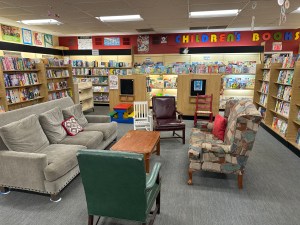
Gramercy’s own contribution to that revival is deliberate. The store feels elegant but welcoming: dark wood shelves, strong signage, a bright white children’s room that makes up nearly a third of both the store’s footprint and sales. Next door, a bakery and coffee shop shares the space through barn doors, encouraging customers to drift between books and conversation. The pairing was intentional. Kass had seen similar models work elsewhere—bookstores creating small ecosystems of complementary businesses—and wanted to build that kind of cross-traffic into Gramercy.

Gramercy Books

What gives the place its energy, though, is its events program. Gramercy hosts about one event a week, sometimes in-store, sometimes off-site when crowds grow beyond the shop’s sixty-seat capacity. Kass curates a mix that ranges widely: haiku poets, romance discussions, national novelists, music-and-book pairings, even large events at an indie film theater or live music venue nearby. For her, the point is connection. Author events, she said, create a “far deeper relationship” between books, writers, and readers.

That sense of relationship shows up everywhere. The staff, Kass said, are “the heart of the store.” They’re knowledgeable, welcoming, and attentive enough to call customers when a book comes in they know they’ll love. In a low-margin business, that kind of care doesn’t come easily. Gramercy now offers health and retirement benefits, something Kass took pride in building toward over time. 

Asked what explains the store’s success, she gave a simple answer: “We just try to do everything well.”

That may also describe what’s happening across Columbus right now. Not flashy, not nostalgic, and not accidental. Just a growing network of stores, each rooted in its own corner, suggesting that the old narrative of literary decline was never the only one.

When I returned to Columbus this summer after nearly twenty years away, I could sense some of that shift—not just in bookstores, but in the city itself, in its pockets of creative space and unexpected gems. Something more confident, more self-defined. Gramercy feels like part of that story now. 

Scott Lambridis

Scott Lambridis is a novelist based in Bellingham, Washington. A former indie press founder, performance series organizer, olive farmer, and progressive rocker, he studied neurobiology at the University of Virginia, earned an MFA from San Francisco State University, and read a book from every country in the world. His debut novel, St. Ulphia’s Dead, is forthcoming from Regal House Publishing on July 7, 2026. Learn more at scottlambridis.com 

Filed Under: Book Bound Tagged With: BookBound, Gramercy Books, Scott Lambridis

The Raven Book Store: Literary Bastion of the Enduring Free State Fortress

May 29, 2026 1 Comment

by Steve Heller

How does one measure the success of an independent bookstore? One obvious criterion is size. The world’s largest independent bookstore, Powell’s City of Books in Portland, Oregon, boasts more than a million titles, with a full city block’s worth of floorspace in which to peruse them. The Strand in New York City claims to house “18 miles of books” on its shelves.

Most notable independents are considerably smaller. City Lights in San Francisco, the USA’s first all-paperback bookstore, houses 34,000 books in 2,100 square feet. Its namesake, Prairie Lights in Iowa City, home of the Iowa Writers Workshop, occupied only half as much space when it opened in 1978. Since both smaller stores continue to flourish in an economy dominated by conglomerates and the world’s largest online retailer, Amazon.com, size clearly isn’t the only consideration.

Every indie bookstore owner I’ve spoken with has maintained there is one factor above all others that determines survival: the ability to connect with the community the store serves. No indie bookstore anywhere illustrates this principle more than the Raven in Lawrence, Kansas.

To know the Raven is to know Lawrence: its culture, politics, and history, all of which are reflected in the books on the shelves inside, as well as in the character of the patrons, employees, and co-owners who move through its aisles.

Politically, I think of the Lawrence of today as a bright blue dot on a blood red prairie. However, that flyover metaphor captures neither the sacrifices of its origin story in the period known as “Bleeding Kansas” (1854-61) and the American Civil War that followed, nor the significance of its endurance as a beacon for civil rights and social justice to this day. Lawrence is named after an abolitionist from Massachusetts, Amos A. Lawrence, who supported the settling of the town through the New England Emigrant Aid Company. The settlers became known as “Free-Staters” and Lawrence itself as the “Free State Fortress” to prevent the Territory of Kansas from being admitted to the Union as a slave state.

Although Lawrence has endured, the Fortress has never been impregnable, as tragically illustrated by the Lawrence Massacre of 1863 by the Confederate irregulars know as Quantrill’s Raiders, which took the lives of 150-200 men and boys. Nor has the Fortress been unassailable from within. Today, Massachusetts Street, the heart of downtown Lawrence, is often the site of protests and demonstrations, often against state and national policies on race, gender, or economic inequities. These are mostly unpopular with locals, but sometimes protests reflect divisions on these same issues within the community itself.

The Raven Facade, photo by Danny Caine

In the heart of the heart of the community, in the 800 block of Massachusetts Street, sits the Raven.

The Raven was founded in 1987 by Pat Kehde and Mary Lou Wright, who established its identity as an indie specializing in mystery novels. Over time, it became known as a general interest bookstore that included fiction, poetry, and history. The original location was on 7th Street between Massachusetts and New Hampshire Streets, in a small, crowded space next to Liberty Hall, around the corner from Free State Brewery. Once one of several independent bookstores downtown, in 1997 the Raven experienced what must have felt at the time like the ultimate existential challenge: Borders Books opened a store right across the street.

Former Kansas Poet Laureate Caryn Mirriam-Goldberg, a longtime Lawrence resident, explains how the book-buying community helped the Raven survive: “We were very nervous about Borders, which was a half block away, but many people like me used Borders to find books, then went to the Raven to order them. My three kids used Borders as a living room, hanging out there to read and get fancy sodas, then we ordered whatever books they loved at the Raven.”

Caryn Mirriam-Goldberg and Hutchinson poet Bill Sheldon chat with the audience at the Raven, March 26, 2026

What engendered this kind of loyalty? According to Mirriam-Goldberg, “What the Raven excels at – and has since ‘87 – is curating the right books for our community and our time along with supporting local authors. Since my first book came out in 2000, I could walk into the store, talk to whoever was working there at the time – sometimes nervously, hoping the store could host a reading – and find a welcoming response.”

L-R Back Row: Kelly Barth, Hannah Reidell, Chris Luxem, Sarah Young.  L-R Front: Nikita Imafidon, Mary Wahlmeier Bracciano, Jack Hawthorn, Danny Caine Photo of the original employee owners by Adam Smith

Mirriam-Goldberg added: “The Raven survived also by being nimble, flexible, and innovative in its ownership. When Danny Caine, owner from 2017 – 2022, needed to move from the area, he brilliantly cooked up an employee ownership model that allowed the store to continue and flourish. Today, the Raven is owned by three people, all former employees who know the store and this community.”

In the end, the Raven (like Papillon) survived, while Borders (like Devil’s Island) did not. The entire corporation declared bankruptcy in 2011, having notoriously failed to adjust to changing public preferences, such as for digital content (streaming) over physical content (CDs and DVDs) for music and films. It also invested too heavily in large high-rent store properties. However, Border’s ultimate undoing was the way it adapted to e-commerce for books, outsourcing its online commerce to what has proven to be the most enduring threat to all indie bookstores everywhere: Amazon.com.

“The Raven Is Moving Here” photo by Nathan Woodward

By the time the Raven moved to its current, larger-but-still-affordable location on Massachusetts Street in August 2021, the COVID pandemic had required not only expansion of e-commerce but innovation in the ways books could be delivered to customers with minimal in-person contact. By the time COVID faded, the new space gave the Raven more flexibility in terms of what it could offer the community, including the return of on-site literary events. In the meantime, many indie bookstores across the nation had closed while Amazon grew even more voracious.

Danny Caine (far right in the above group photo) is the owner who developed the strategy to successfully resist the most rapacious consumer of small businesses since Wal-Mart: educate the book-buying public about the true cost of tax-subsidized corporations such as Amazon, as well as the true value of face-to-face service in community-based bookstores such as the Raven. I could go on and on about this stance, but the best source on the subject is Caine himself. His article/became a viral e-zine/became a book/became a national anthem: How to Resist Amazon and Why: The Fight for Local Economies, Data Privacy, Fair Labor, Independent Bookstores, and a People-Powered Future:

The attention generated by the viral e-zine and popular book, along with Casey Cep’s profile in The New Yorker, preceded the Raven’s 2022 selection by Publisher’s Weekly as the Best Bookstore in the USA.

That same year, Caine sold his 51% interest in the Raven to three of the seven other previous co-owners/employees: Kelly Barth (back row, far left of the group photo), Chris Luxem, and Mary Walmeier Bracciano (front, second from left). Caine moved back to his native Cleveland, Ohio to take his struggle with corporate America to the next level, working for the Institute of Local Self-Reliance, an advocacy organization that supports local retailers against big-box stores and other corporations.

When I asked Chris Luxem how his own responsibilities have evolved since becoming a co-owner, he replied, “I started working at the Raven in 2014. I definitely understand the misconception that an owner is making all the decisions regarding the store, but as long as I have worked here it’s been an extremely collaborative experience. Heidi Raak was the owner when I was hired and she led the store with a forthrightness that started the mission of the Raven to be as inclusive as possible and equitable between booksellers and owner, allowing Danny Caine to purchase the store in 2017. Danny Caine made me and six other employees minority owners in 2021.”

Luxem went on to further stress the necessity of collaboration: “I definitely have learned a lot more about the backend aspects of the business. Kelly, Mary, and I all do different roles. I’m essentially the General Manager and Finances Manager. I do the accounting and also help a lot on the sales floor during the days to make sure everything is running smoothly. In terms of three people making decisions, we all have very different reading tastes and management styles, so we can help fill in the gaps when necessary and offer perspective to the other two that may not be as obvious for any number of reasons. We’ve continued the collaboration with booksellers because we know certain reading styles will help fill the gaps even more where we might not be in tune. For example, Romance and Romantsy (Romance+Fantasy) have been an ever-growing section in the store and continue to evolve thanks to dedicated Romance-reading booksellers.”

Interior of the Raven facing Massachusetts Street. Photo by Carlos Moreno

The Raven is known for hosting numerous readings, signings, lectures, and other literary events. Co-owner Kelly Barth, who has worked at the Raven for almost 30 years, says the biggest problem with in-store events is making sure the event features the right writer(s). “Big names are a good draw, of course,” Barth says, “but local authors are very important in terms of attracting an audience.”

Chris Luxem added: “Hosting visiting authors as well as local authors is essentially about continuing the community building that a space like ours can offer. We’ve had a litany of world-famous authors come through our doors as well as self-published one-time authors. All of their works have immense value to increase the visibility of the store, but also just love for literature. We get a lot of requests and much of the decision making is put to a group vote, but also some are just too good to pass up, or are very topical in terms of current events, or local interest. It’s nice to offer a lot of different types of events for the community because you never know what will resonate with people. We also sell at a lot of off-site events with authors at the Lawrence Public Library, Liberty Hall, Watkins Museum, Lied Center, even the Bowlus Fine Arts Center in Iola, KS have had us attend events as booksellers.”

Raven T-shirt photo by Amanda Wilson

Denise Low-Weso, another former Poet Laureate of Kansas, lived in Lawrence for decades and read at many events hosted by the Raven. Low-Weso, who has retired to the wine country of Sonoma County, California, still returns to Kansas for literary events at the Raven and other venues. “When my husband Tom Weso’s book, Good Seeds, came out, Restaurant 715 hosted a happy hour that featured recipes from his book. Afterwards, brushing crumbs from our mouths, we walked in a cold wind the entire block to The Raven for a lovely reading. And I launched a breakthrough book, Melange Block, there in 2014. I had friends each read a poem from it and then a poem of their own. There was a full house and I sold 50 books—of poetry!”

The Raven’s website states that the books sold in the store are “intentionally curated to represent voices that have long been under-represented, especially those in the queer community.” A casual visit to the store easily confirms that. Like all bookstores, shelf space at the Raven is limited. I asked Chris Luxem how he and his fellow co-owners and booksellers determine which books are placed on the shelves.

“Essentially,” Luxem replied, “we all have different reading tastes and also different cultural influences. I help curate a lot of the essay, music, philosophy, short stories, political science selections. Mary curates the entire Children’s section and also does the restock ordering for the entire store, so she has an idea of the books we need multiple copies of at all times. Kelly does the ordering for Adult titles that have yet to be released (Frontlist titles) but also specializes in Mysteries, Science, and Literary Fiction titles. We have a bookseller who is an art historian so she curates our art books. We have a science fiction specialist who helps curate both unreleased and classic Science Fiction titles for the store. I mentioned the Romance reader. We have a lot of folks on staff who love Fiction, which is our biggest section, so we all kind of add different choices to the fiction shelves over the months.”

Raven interior, Vermont St. side

In her record four years as Poet Laureate, Caryn Mirriam-Goldberg gave readings and talks throughout the state. I asked her about the Raven’s reputation across Kansas:

“I’ve had the honor of connecting with many independent bookstores in Kansas, including Eighth Day Books in Wichita, Flint Hills Books in Council Grove, and Middle Ground Books in Emporia, and I’ve seen the evolution and continuation of these and other stores as centers of hospitality, literacy, and the transformative power of language – just like the Raven. The owners of some of these stores have shared with me that they find inspiration in and guidance from the Raven.”

Mission-driven, community-oriented, employee-owned and operated, the Raven serves as an exemplar for the most passionate advocates of literary culture, social justice, and freedom of expression.

The Raven Book Store is located at 809 Massachusetts Street, in Lawrence, KS 66049. Find the Raven at ravenbookstore.com.

Steve Heller is an award-winning novelist and short story writer and past President of The Association of Writers and Writing Programs (AWP).  His latest novel, Return of the Ghost Killer, is forthcoming from Regal House Publishing on January 19, 2027.  He lives in Lawrence, Kansas.

Filed Under: Book Bound Tagged With: BookBound, Kansas, Lawrence, Steve Heller, The Raven Book Store

Dog Eared Books: The Store That Always Has the Right Book

May 26, 2026 Leave a Comment

By Scott Lambridis

Around 2005, a young kid named Cassius tried to steal a graphic novel from Dog Eared Books in San Francisco’s Mission District. He slipped the book under his jacket and headed for the door, but a bookseller caught him. The kid burst into tears. Ryan, who has worked at the store for more than twenty years, still remembers the moment. They scolded the kid. They made it clear he couldn’t do that. And then they gave him the book.

These days Cassius is grown—“a tall, handsome adult,” Ryan told me—but he still drops by the shop when he visits his mom. It’s a small story, but it says a lot about Dog Eared Books, a small store, packed tightly into a corner of Valencia Street. It’s warm, human, a little chaotic, and inseparable from its neighborhood. That reflection of the neighborhood is why they always seem to have exactly the right book. 

For a few years, I took part in a monthly book club devoted to NYRB Classics, hosted by Dog Eared. They always had a dedicated shelf to the Classics series, but more than that, the shelves always held unexpected delights: European novellas, lost modernists, odd little translations that felt unlikely to be found anywhere else. Ryan explained the secret:  “The books we have on the shelves reflect the community.”

Most of Dog Eared’s used inventory comes directly from the Mission’s readers, people bringing in the books they’ve finished or no longer have room for. The result is a kind of literary ecosystem. The neighborhood supplies the raw material. The booksellers shape it. Dog Eared has always leaned into that treasure-hunting culture. From the beginning, the store blended used books with new titles and remainders—publisher overstock discovered through the kinds of scavenger hunts booksellers love. “You have to enjoy looking for treasure if you work at a used bookstore,” Ryan said.

But the real work is curation. With such a small footprint, nearly every book has to earn its place. “Ninety percent of the job is picking the right books,” Ryan told me. Luckily, San Francisco gives them the freedom to take risks. “It’s a literate city. Thank goodness.” Just as important, the store avoids the trap that sinks many used bookstores: snobbery. “We’ve done a pretty good job not being jerks,” Ryan said with a laugh.

The result is a place that’s tidy enough to browse, adventurous enough to surprise you, and welcoming enough that even a kid caught stealing comes back, year after year after year. Our NYRB Classics book club has since gone online as members moved to other locales, and the store has changed owners, but whenever I’m in San Francisco, Dog Eared is still the first place I go. It’ll no doubt have exactly the book I didn’t know I was looking for.

Scott Lambridis

Scott Lambridis is a novelist based in Bellingham, Washington. A former indie press founder, performance series organizer, olive farmer, and progressive rocker, he studied neurobiology at the University of Virginia, earned an MFA from San Francisco State University, and read a book from every country in the world. His debut novel, St. Ulphia’s Dead, is forthcoming from Regal House Publishing on July 7, 2026. Learn more at scottlambridis.com 

Filed Under: Book Bound Tagged With: BookBound, Dog Eared Books, San Francisco, Scott Lambridis

Borderlands Books: The Store Its Readers Refused to Lose

May 19, 2026 Leave a Comment

by Scott Lambridis

For years, a man named Michael came into Borderlands Books in San Francisco. He lived in residential hotels and worked occasionally as a book scout, finding used books to sell around the city. He loved science fiction, especially Fritz Leiber, and he liked to talk about it. Sometimes at length.

Jeremy Lassen, who has worked at Borderlands for nearly three decades, remembers Michael clearly. The store’s cat would often curl into his lap while he sat reading quietly in the corner.

Then one day a letter arrived. Michael had moved to Florida and learned he had a brain tumor. In the letter he apologized if he had ever behaved strangely in the store. But mostly he wanted to say thank you. Being able to sit in Borderlands with a book and a cat in his lap, he wrote, had been one of the most important things in his life during that time.

Before Borderlands was a bookstore people rallied to save, it was a place that made room for people like Michael. The store began in 1997 when Alan Beatts, a lifelong science fiction reader, looked around the Bay Area and decided the genre deserved a better kind of bookstore. Many independents at the time still carried the cluttered aesthetic of the 1970s: dim lighting, dusty shelves, books stacked wherever they would fit.

Beatts imagined something else: a clean, well-lit, carefully organized bookstore devoted entirely to science fiction, fantasy, and horror. Jeremy met him while working at another indie bookstore in the Bay Area. After months of showing up every Sunday as a customer, Beatts finally told him, “You’re in here all the time anyway—want a job?”

He’s been there ever since.

From the beginning, Borderlands made a few deliberate choices. The store would stay focused on books. No figurines, toys, or novelty merchandise competing for shelf space. It would skip media tie-ins and franchise novels entirely. If a book didn’t stand on its own as literature, it didn’t belong.

“That shelf space could be more books,” Jeremy told me.

The store’s atmosphere reflects the same philosophy. Wooden fixtures, vintage rugs, and refinished hardwood floors give it a quiet, crafted feel with much of the work done by Beatts himself. The effect is welcoming but serious, a place designed for readers rather than collectors of memorabilia.

But survival in San Francisco has required more than good taste. Borderlands has been forced to move several times as landlords changed and rents rose. At one point, a minimum wage increase threatened to close the store entirely. When Beatts explained the numbers, customers responded with a simple question: could they help? They could. A few hundred patrons began contributing a few hundred dollars a year. It became enough to sustain the store for the next decade.

More recently, the community helped again. After years of lease instability, Borderlands borrowed the money to purchase its own building, not from a commercial bank but from readers who wanted the store to remain. It’s fitting that their logo is the ouroboros. Like the snake eating its own tail, there’s a recursive continuity at Borderlands, where customers sustain the store that, in turn, sustains them in a perpetual cycle of renewal. It also makes Michael’s story feel less like an anecdote than an explanation. A bookstore that gives people a place to belong will eventually find that it belongs to them, too.

Scott Lambridis

Scott Lambridis is a novelist based in Bellingham, Washington. A former indie press founder, performance series organizer, olive farmer, and progressive rocker, he studied neurobiology at the University of Virginia, earned an MFA from San Francisco State University, and read a book from every country in the world. His debut novel, St. Ulphia’s Dead, is forthcoming from Regal House Publishing on July 7, 2026. Learn more at scottlambridis.com 

Filed Under: Book Bound Tagged With: BookBound, Borderlands Books, San Francisco, Scott Lambridis

Fabulosa Books: The Castro’s Living Room

May 12, 2026 Leave a Comment

by Scott Lambridis

A young man from Texas walked into Fabulosa Books, looked at the wall of queer titles, and started crying. “Is this all gay stuff?” he asked. When an employee named Becka told him yes, the young man asked if he could hug her. Moments like that, owner Alvin Orloff says, are why the bookstore exists. “People are traumatized,” he told me. “It’s really important for them to be able to buy queer stuff in public and see it all there.” 

Fabulosa Books sits on Castro Street, in the space once occupied by A Different Light, the legendary queer bookstore that helped anchor the neighborhood through the AIDS crisis. When that store closed in 2011, the Castro went five years without a bookstore at all.

Orloff had been working for years at Dog Eared Books on Valencia Street, one of San Francisco’s beloved literary hubs. I first met him there when he hosted a monthly NYRB Classics book club I was part of. In 2016 he helped open a Dog Eared branch in the old A Different Light location, bringing a bookstore back to the Castro—and bringing with it the kind of literary curation he loved: small presses, forgotten classics, and books that would never appear in an airport kiosk. 

Then, in 2019, at the release party for Orloff’s own memoir, his boss leaned over and made an offer. Did he want to buy the store? Orloff said yes. Then the pandemic shut everything down. “I was leaving the house to go file the papers,” he said, laughing. “And City Hall closed.”

For a while, the idea stalled. Castro Street, he says, was “dead, dead, dead.” But two years later, staring down his 60th birthday, he decided to go for it. “Now or never,” he said. “I’ve got to become a bookstore magnate.”

In 2021 he bought the store and renamed it Fabulosa Books. At first, the shop wasn’t especially LGBTQ-focused. But after the 2016 election and a noticeable shift in national rhetoric, Orloff began expanding the store’s queer inventory. What started as maybe 10 or 15 percent of the stock grew to more than half.

“The more homophobic society becomes,” he said, “the more people circle the wagons and reclaim their identities.” Today, the store’s identity is unmistakable. The LGBTQ section greets visitors right at the front door. The space itself is bright and airy—more open than Dog Eared’s famously packed Valencia shop—with local art on the walls and a small corner of stickers, buttons, and postcards for tourists or anyone who wants a keepsake they can slip into a carry-on.

Fabulosa has to wear two hats at once: the Castro’s queer bookstore and its only general neighborhood bookstore. That means stocking everything from queer memoirs to popular fiction to obscure literary gems. Orloff doesn’t mind the balancing act. “You can’t take your parents to the gay bar,” he said. “But you can bring them to the bookstore.” Couples wander in on dates. Tourists make pilgrimages after reading Tales of the City. Parents sometimes bring newly out kids. “They come in slightly freaked out,” he said, “and leave slightly less freaked out.” 

That moment between Becka and the young man from Texas helped spur her to start Books Not Bans, a nonprofit hosted by Fabulosa that sends banned books to LGBTQ+ organizations in conservative areas.

The business realities remain challenging—rents, online shopping, the shrinking culture of public literary events—but Orloff approaches it with both realism and humor. “I’m not in charge of whether people want a robust literary culture,” he said. “What I can do is make this bookstore as appealing as I possibly can.”

Some things carry forward. “We still do NYRB Classics,” he told me. “We’ve got a shelf.” It’s one of those quiet throughlines from the book club I knew at Dog Eared to the store he runs now.

In a neighborhood built on visibility, Fabulosa has become exactly what the Castro has always needed.  Like it was for that young man from Texas, it’s more than a shop. It’s a place where you can browse, talk books, and maybe recognize someone else who understands why it matters.

Scott Lambridis

Scott Lambridis is a novelist based in Bellingham, Washington. A former indie press founder, performance series organizer, olive farmer, and progressive rocker, he studied neurobiology at the University of Virginia, earned an MFA from San Francisco State University, and read a book from every country in the world. His debut novel, St. Ulphia’s Dead, is forthcoming from Regal House Publishing on July 7, 2026. Learn more at scottlambridis.com 

Filed Under: Book Bound Tagged With: BookBound, Fabulosa Books, Scott Lambridis

Tsunami Books — A Beloved Bookstore Moves to Buy the Building

May 8, 2026 Leave a Comment

by Amalia Gladhart

Over the course of thirty years, Tsunami Books in Eugene, Oregon, has hosted thousands of readings, theater revues, writers’ workshops, and concerts. The eclectic stock includes new and used books, with a strong selection of local authors; anything you can’t find, they’ll gladly order. It’s my neighborhood bookstore. I’ve attended readings, listened to music, and read from the stage myself.

Murals, sale racks, and a glorious fig tree frame the entrance. Inside, the light is warm and comfortable. There’s a welcoming quiet, the scent of beeswax from a shelf of candles, the up and down hum of conversation among browsers and staff. Kept afloat by a talented, hardworking crew of worker-owners, Tsunami has enjoyed unusual community support and investment. Now, in addition to a full calendar of music and book events and publication projects, co-founder and general manager Scott Landfield is leading an effort to buy the building.

Scott and I sat down on the stage—built, like the surrounding shelves, from gorgeous recycled lumber—to talk about Tsunami past and present. It’s been thirty years. It’s been a struggle, every month, scrapping for rent. At the start, they occupied only the front of the building. In 1998, they were told they had to take over the whole building or move out. The back half, a former grocery warehouse with two inches of standing water on the floor, needed extensive remodeling.

The recycled lumber used to build the shelves and stage is a clear point of pride for Scott. Schools and colleges across Oregon and Washington were pulling out their wooden gymnasium bleachers, replacing them with plastic or aluminum. Wood from some thirty-five schools is incorporated, as well as Lane County native wood.

There’s a lot to be proud of. Over 5000 events and activities. Musicians who come praise the acoustics. Scott has been active in making the street more pedestrian friendly and hospitable to business, convincing the city to install a traffic light and reduce the speed limit. Tsunami Press has published a couple of books. Their second book, Bookstore Clerks and Significant Others, got a starred review from Kirkus, and Kirkus picked it one of the top 100 indie press books of 2024. They’ve hosted a lot of wakes, Scott told me, including a living wake for a man in his nineties; they had to bring in a hospital bed. They’ve hosted three weddings.

And the community. “The thing about this place is the way the community has stepped up, so many times,” Scott said. The first round came in 2005. Burnt out and considering bankruptcy, Tsunami announced a going out of business sale, aiming to sell everything and get out of debt. Instead, a trio of community members offered a $35,000 stake if they’d keep the store open. At that point, Tsunami established a Neighborhood Shareholder Corporation. Shares were limited, with consensus required to move any shares. When the building owner later decided to sell, giving Scott thirty days to come up with the purchase price, a local developer stepped in at the last minute to buy the property, allowing the store to continue for two years on a handshake agreement. When it came time to sign a new lease, however, Scott didn’t own a house he could put up as collateral—a standard requirement—so he was asked to place $302,000 in an escrow account. That led to the second big fundraising push. Scott created a form of local crowdfunding that quickly raised more than was needed (the overage immediately returned to donors).

Why try to buy the building now? There are a few reasons. After thirty years, they’ve paid almost two million in rent. It feels like time. They’ve been able to hire and retain a skilled and imaginative staff, yet the crew, despite earning a respectable hourly rate, lack health insurance; none of them are homeowners. Scott takes home less than minimum wage. The current building owner has been decent, has made accommodations, but rent is still a stretch. A new partnership with the Eugene Foundation, supporting the store’s arts events (not rent or payroll), got people thinking about the possibility of a nonprofit ownership structure. [https://www.eugeneparksfoundation.org]

Most of all, the initiative is a response to hard times, to war and frustration; it’s a move to do something proactive. Last year was difficult. When Scott wrote an article in the Eugene Weekly about buying local during hard times, supporting your favorite local businesses, business took off for about two months. That’s when the Parks Foundation came in.

Scott choked up when he talked about being in the store the Saturday after the war in Iran broke out, grappling with the senseless deaths of so many girls when their school was bombed. It hit him hard. And at the same time, the store was packed. Scott told me it was like COVID, as if people got a notice: time to get some groceries, get some books, and hang out at home for a while. It was three days of worried customers looking for books and some kind of reassurance. People needed to be together, needed to laugh. He described it as a weird form of hysteria: on the one hand, his grief and anger at the war; on the other, the urge to comfort people, put them in a good mood. “It’s best if hysteria leads to hysterical laughter,” he said. “Some of the best one liners I’ve ever had in my life, and not about the system, not about the war, none of that stuff. So there was a lot of laughter in the building.” But after three days—three days of record sales— it was too much. What could we do? he asked himself. Tsunami had to do something.

Scott announced his intention to buy the building. He got permission from the other bookstore owners. The goal: keep a key place of property in music and arts. Then he built a tip box. The plan was to put out the tip box for thirty days while they figured out what to do next. To buy the building, Tsunami would need to raise a million dollars.

The box, built using wood scraps from six different sets of grade school bleachers, raised $14,000 in thirty days. The idea caught on—now people come into the store excited, asking how the purchase effort is going. They want to take part, join in.

The next step is a GoFundMe, slated to go live on May 1. Scott hopes to bring in $5 or $10 each from a hundred thousand people. If they can raise a solid chunk in small donations, he’s optimistic he can find a few larger donors. A successful purchase will include a legal covenant, one that will keep the property in books, music, and the arts in perpetuity. If it changes hands, the covenant goes with it. Nothing will come out of the GoFundMe until it’s clear a deal is going forward—if they can’t raise enough, everything will be refunded.

Why might readers beyond Eugene be moved to contribute? Because of that promise. Because of community, art, survival. Worker-owners. Laughter in the face of grief and frustration. Musicians from twenty-five countries playing their songs and telling their stories. Poets reading their poems.

What’s Scott looking forward to? Reasons to stay active for another ten years. Staffer Emily Poole’s book is coming out in September and they plan to fill the building with artwork. She’s also working on the cover for a second Tsunami anthology. There’s a secret stash of unpublished Ken Kesey work, other local treasures Scott has an eye on.

“We wanted to come up with a big idea,” Scott told me, “but the big idea came up with us. We have built a country where we can rest on our laurels very well. Very well. But we need to be proactive. You don’t create world peace by creating a department of war. Keeping a key piece of property in simple arts, in music and books, is what we can do here.”

He concludes, “It’s a counter-offensive. I’m not using the term war. It’s not a battle. It’s just people getting by in the world.” He thinks, ultimately, that’s what a great many people are looking for. People who want to read books, hear music, and go home to a roof over their heads.

Amalia Gladhart is a writer and translator in Oregon. A former bookseller—both new and used—she is always on the lookout for a good indie bookstore. Her novel, Edge Pieces, is forthcoming from Regal House in spring, 2028. Learn more and subscribe to her newsletter at amaliagladhart.com.

Filed Under: Book Bound Tagged With: Amalia Gladhart, BookBound, Tsunami Books

Kepler’s Books: Building a Bookstore Around Its People

May 5, 2026 Leave a Comment

by Scott Lambridis

Kepler’s Books in Menlo Park has the reputation of an institution. Founded in the 1950s by peace activist Roy Kepler, it was once a gathering place for Beat thinkers, Stanford students, and even early performances by the Grateful Dead.

But when I sat down with Community Engagement Officer (CEO) Praveen Madan last year, that history wasn’t what stayed with me most. What stood out was a simple idea: Kepler’s isn’t trying to build the best bookstore around books. It’s trying to build the best bookstore around its people.

When Praveen first became involved with Kepler’s, he came from the corporate world and had never run a bookstore before. The store had faced closure before—most dramatically in 2005, when news of the shutdown sparked protests and drew thousands into the plaza outside.

By the time Praveen arrived in late 2011, the situation was quieter but no less urgent. The board had again decided to close the store, this time before the news had spread publicly. What followed wasn’t a public outcry, but months of behind-the-scenes work: restructuring debts, raising funds, and reimagining what the bookstore could be. The message, even then, was clear: this place mattered.

Soon Praveen found himself stepping into the vacuum of leadership. “There wasn’t really an owner,” he told me. “They just expected me to run it.”

What followed was less a rescue than a reinvention.

Praveen believes the real competitive advantage of an independent bookstore isn’t price, inventory size, or logistics. It’s the staff. “Our biggest asset is our people,” he explained. The booksellers are the first line of curation—the people who decide what appears on the shelves and what gets recommended to readers.

And at Kepler’s, that curation shows. Though the store itself isn’t enormous, almost every shelf intrigues: literature in translation, unusual small-press titles, books about nonviolence or sustainability, unexpected staff picks.

Praveen described a constant gravitational pull in bookselling. If you’re not careful, the catalogs of the biggest publishers can quietly take over your shelves. “They have the big sales teams, the big titles,” he said. “If you’re not paying attention, the Big Five will consume your store.” Kepler’s fights that gravity intentionally, highlighting independent presses, diverse voices, and books that might otherwise be overlooked.

One bookseller, Jasmine, described their approach this way: they feature “not the sparkly famous person book for kids, the beautiful one that you’ll love in 50 years.”

They pay attention to what people want, but also to what they believe people might need. A good bookstore finds the balance between both. Each year they even publish a holiday list of 80 staff recommendations, a customer favorite.

But building a staff capable of that kind of curation requires something bookstores have historically struggled to offer: decent wages.

So Kepler’s made an unusual decision. Instead of maximizing profit, they decided to maximize wages. The store aims to devote roughly 35% of its revenue to staff compensation, far higher than the industry norm.

To make that work, they experimented with creative solutions: a voluntary living-wage surcharge, a membership program, and perhaps most significantly, a structural innovation. Kepler’s spun off its extensive author-events program into a nonprofit—the Kepler’s Literary Foundation—so the bookstore itself wouldn’t have to subsidize those events with retail profits.

The result is a hybrid model that has drawn attention from bookstores across the country, and the Reimagine Bookstores campaign, which Praveen helps lead.

Standing in the store, watching customers browse shelves curated by booksellers who love what they do and feel well-supported, the logic seems obvious. If you want a great bookstore, you start by taking care of its people. 

Scott Lambridis

Scott Lambridis is a novelist based in Bellingham, Washington. A former indie press founder, performance series organizer, olive farmer, and progressive rocker, he studied neurobiology at the University of Virginia, earned an MFA from San Francisco State University, and read a book from every country in the world. His debut novel, St. Ulphia’s Dead, is forthcoming from Regal House Publishing on July 7, 2026. Learn more at scottlambridis.com 

Filed Under: Book Bound Tagged With: BookBound, Kepler's Books, Scott Lambridis

Green Apple Books: A Thousand Small Improvements

April 28, 2026 Leave a Comment

by Scott Lambridis

I arrived at Green Apple Books as they were opening for the day. Staff were rolling carts of sale books onto Clement Street, those irresistible sidewalk stacks I had to convince myself to ignore. 

Inside, the store feels a little like an oversized San Francisco apartment that somehow kept expanding over the years. The floors change beneath your feet. Hallways narrow and widen. Odd-sized stairs appear and disappear. The layout twists and turns in multiple dimensions, unified only by the bookshelves and, perched high on top, a dizzying array of art and strange artifacts. There’s a sense that if you turned away for a moment, something might shift.

Pete Mulvihill, one of the store’s owners, led me through the maze. We settled into a pair of chairs upstairs in the philosophy section, appropriately under reconstruction. Green Apple is, at its core, the result of steady adaptation. 

The original owner opened the shop while working for United Airlines, running it only on weekends at first. “This used to be an apartment,” Pete told me. “He just gutted it and put in bookshelves. Cut a hole in the wall.” Over time, the store expanded into neighboring spaces, something that would be far harder to do today. 

From the beginning, the philosophy was to respond to readers. “Sell more of what’s selling,” Pete said, recalling the founder’s advice. 

But that instinct has always been in tension with something else: curation.

“Bad books hide good books,” he said.

Green Apple is legendary among hardcore readers for its collection. Every time I visit, the shelves overflow with titles from my to-read list, and even the briefest of browsing yields new gems. Featured sections like Customer Favorites, the Green Apple Hall of Fame, and 50 Years of Green Apple show the glory of not just their lineage but the taste of the curators. 

That’s the point. If you have to sift through noise to find something worthwhile, the whole experience breaks down. 

That balance between responsiveness and discernment is shaped as much by economics as by taste.

Books have fixed prices. Margins are thin. Rent and labor costs in San Francisco are a constant challenge. “If publishers gave us five percent more,” Pete said, “there’d be twice as many bookstores.” And Amazon, of course, is always there, training customers to expect speed and discounts that independent stores simply can’t match. 

So survival comes down to all the other decisions. 

Used books help, though they require more labor, each one bought, evaluated, and priced by hand. Staff curate deeply, sometimes sourcing titles from overseas or working directly with tiny publishers. “We’ll go out of our way for something special,” Pete said. “Even if I have to put it on a credit card.” 

The store also thinks beyond the transaction. Pete helped found San Francisco’s “Local First” initiative, built around a simple idea: shopping locally keeps money circulating locally. Studies showed that roughly 62% of a bookstore purchase stays in the community—compared to effectively none with Amazon. Green Apple has leaned into that ethos, supporting neighborhood events, street improvements, and the kind of independent commercial fabric that Clement Street still manages to sustain.

And then there are the thousand small experiments. 

Some are subtle, such as shifting shelf space, refining sections, adjusting inventory. Others are more direct. Pete described one recent success: “a staff member suggested ‘dad-style’ baseball caps, and they sold so quickly that we ended up ordering 1,000. It’s fun spotting them out in the world.”

Events are another piece of the equation. While the Clement Street store hosts smaller readings, much of Green Apple’s programming now happens at its second location across Golden Gate Park, a space designed to hold larger crowds. For even bigger events, they’ll even go offsite. As a result, the store can host everything from intimate conversations to major literary events such as a feature with Ocean Vuong. Sometimes things get weirder. Pete told me about one appearance by Dave Eggers, who once offered relationship advice from a booth. On another occasion, he gave haircuts to a couple of brave volunteers.

“That big event pays for the little poetry reading where two people buy a book,” Pete said.

It’s all part of the same system: a store constantly adjusting, constantly redistributing energy from one part of the business to another.

“It’s the opposite of death by a thousand cuts,” Pete said. “It’s a thousand little improvements.”

It’s the perfect description. Not just of how Green Apple survives, but of how it feels to walk through it. 

Scott Lambridis is a novelist based in Bellingham, Washington. A former indie press founder, performance series organizer, olive farmer, and progressive rocker, he studied neurobiology at the University of Virginia, earned an MFA from San Francisco State University, and read a book from every country in the world. His debut novel, St. Ulphia’s Dead, is forthcoming from Regal House Publishing on July 7, 2026. Learn more at scottlambridis.com 

Filed Under: Book Bound, Regal House Titles Tagged With: BookBound, Green Apple Bookshop, Scott Lambridis

  • Page 1
  • Page 2
  • Page 3
  • Page 4
  • Go to Next Page »

Footer

The Regal House Enterprise

Regal House Publishing is the parent company to the following imprints:

Fitzroy Books publishing finely crafted MG, YA and NA fiction.

Pact Press publishing finely crafted anthologies and full-length works that focus upon issues such as diversity, immigration, racism and discrimination.

The Regal House Initiative, a 501(c)(3) nonprofit that conducts project-based literacy and educational outreach in support of underserved communities.

From our Blog

Gramercy Books and the Quiet Revival of Columbus Bookselling

The Raven Book Store

The Raven Book Store: Literary Bastion of the Enduring Free State Fortress

Dog Eared Books: The Store That Always Has the Right Book

  • Facebook
  • Twitter
  • LinkedIn
  • Google +
  • Email
Regal House Publishing · © 2017–2026 · Website design by Lafayette & Greene

Loading Comments...