• Skip to primary navigation
  • Skip to main content
  • Skip to footer

Regal House Publishing

Advancing Finely Crafted Literature

  • Home
  • About Us
    • The Origin Narrative of an Indie Press
    • The Regal Mandate
    • Our Imprints
    • The Regal House Initiative
    • Regal House Publishing Staff
    • Our Professional Affiliations
    • RHP’s Climate Commitment
    • Helen Keller Intl
    • RHP Summer Scholars Program
    • Contact & FAQ
    • Blog
  • Authors
    • Our Authors
      • Regal House Authors & Poets
      • Fitzroy Books Authors & Poets
      • Pact Press Authors & Poets
    • Forthcoming Publications
    • Sour Mash: RHP’s Southern Literature Series
    • Fugere Books: RHP’s Novella Series
    • Regal House Reading Series
    • Author Resources
  • Submissions
  • Marketing & Distribution
    • Our Distribution and Printing Partners
    • Subsidiary Rights
    • For Retailers
    • Events
    • A Conspiracy of Lemurs Podcast
  • Contests
    • The Fugere Book Prize for Finely Crafted Novellas
    • The Petrichor Prize for Finely Crafted Fiction
    • The W.S. Porter Prize for Short Story Collections
    • Past Contests
      • The Kraken Book Prize for Middle-Grade Fiction
      • The Acheven Book Prize for Young Adult Fiction
    • The Terry J. Cox Poetry Award
  • SHOP

Regal House Titles

Steven Mayfield: “It’s Hard to Make Up Stuff that Good”

April 1, 2020 1 Comment

Writers are always advised to write what they know. I don’t disagree, but think that it’s how you come to know about something that matters. I once took a class from Roger Welsch, the renowned folklorist. He advised us not sell ourselves short on what we knew, recalling a previous student flummoxed by her lack of worldly experiences upon which to draw. Dr. Welsch gave her an assignment. “Think of something about your family that you find interesting.” The girl came back with the following tale: Her grandmother and grandfather lived in a small Nebraska town where everyone knew each other. It was in a time when people talked over the back fence and hung their laundry on a clothesline. Every week the girl’s grandmother washed her husband’s pajamas and hung them on the line. When they were dry, she neatly folded them and placed the PJs in a dresser drawer where they remained until the next week when she removed the clean, unworn pajamas, rewashed them, and again hung them on the line. Why did she do this?

“Well,” the girl told Dr. Welsch, “my grandpa slept in the nude and my grandma didn’t want anyone to know.”

“It’s hard to make up stuff that good,” Dr. Welsch told his student.

So, she did have something to write about, even though it wasn’t drawn from her own experience. She’s not alone. Frank Herbert created the world of Dune, J.R.R. Tolkien the inhabitants of Middle-Earth, J.K Rowling the wizard’s school at Hogwarts. My next book, Treasure of the Blue Whale, describes a town and a time period that I never knew. Don’t blame me for such presumptuousness. Blame Alastair MacClean. When I was a teenager, I loved books by MacClean, the Scottish schoolteacher who wrote The Guns of Navarone and other adventures. His tales of mountain-climbing commandos, nuclear submarines, and double agents were concocted without actual experiences. He did not learn about such people and things by scaling Matterhorn, doing battle with Blofeld, or splitting an atom. He went to the library. Afterward, he didn’t write what he knew; he knew what he wrote.

The Golden Gate Bridge in San Francisco, CA at sunset.

A few years ago, when I lived in San Francisco, I picked up my wife from an appointment in Pac Heights. When I pulled up to the curb, she was waiting alongside a very old man. “This is Zane,” she told me. “We’re giving him a ride.”

Zane got in the car and introduced himself. “Thank you for your kindness,” he said. “In exchange, you will get a really good story.”

Zane was 90 years old and Nisei—born in America—the son of a Scotch-Irish mother and a father who was Issei—born in Japan. He’d gone to high school in San Francisco, graduating in 1942 just a few months following the attack on Pearl Harbor. Not long thereafter, Zane and his parents were shipped off to an internment camp in Utah. He spent a year there before being allowed to enlist in the Army.

“I moved to New York City after the war,” he told us. “I lived there for twenty-six years. I was a dance instructor.” He offered to give my wife and I free lessons. He said the rumba was easiest and we’d start there.

Zane’s home was in an assisted living facility not far from the Golden Gate Bridge. The sidewalk fronting the building was steep and we offered to help him to the door. “I can make it,” he assured us. “Have you heard of Michael Jackson? He did the moon walk. I can do the moon walk, too.”

And then he did.

“He was interesting,” I said to my wife as we drove home. I was already planning the book I would write, one currently in progress.

“Yes he was,” she replied, “he was very sweet. And his story…can you believe it? Why, you just can’t make up stuff that good.”

Steven is the past recipient of the Mari Sandoz Prize for Fiction and the author of over fifty scientific and literary publications that have appeared in Event, The Black River Review, cold-drill, artisan, The Long Story, and the anthology From Eulogy to Joy. In 1998, he was the guest editor for Cabin Fever, the literary journal of the Cabin Literary Center. He is the author of Howling at the Moon, a Best Books of 2010 selection by USA Book News as well as an Eddie Hoffer Finalist.

Filed Under: Literary Musings, Regal Authors, Regal House Titles Tagged With: Steven Mayfield, Treasure of the Blue Whale

Ill-Fated Lovers: Writing About Socioeconomics and Race

March 2, 2020 3 Comments

Writing Bliss presented several challenges which I would divide into two categories: the literary and the personal.

Portraying the impediments to Danielle and Connor’s relationship—the central plot of Bliss—was challenging primarily because those impediments are societal, as opposed to interpersonal or circumstantial. It would be one thing if they were merely too stubborn or prideful to admit their feelings, if they only misunderstood each other (which, for much of the novel, they do), or if they were from rival families, he a Montague, she a Capulet. But it is their socioeconomic and racial differences that threaten the love between them, and capturing the implications of these differences was thorny. Societal constructs are both omnipresent, all-powerful and insidious, and rarely discussed in everyday life, much less between two individuals from completely different backgrounds, like Danielle and Connor.

Connor, raised amid affluence and ease in a predominantly white community, has never reflected much on the luxuries of his race, which are apparent to Danielle, raised amid poverty and strife in a predominantly black community. More, she cannot comprehend why someone would forgo the opportunities wealth has offered him, as Connor attempts to do in the beginning of the novel. A rec center employee devoted to the needs of underserved children, she knows that luxury and opportunity are rare and precious blessings, and falling in love with someone who doesn’t understand this feels to her like a betrayal of her community. They are each caught between two worlds—their own and their lover’s—worlds their love can reveal but perhaps never reconcile. Perhaps.

Bliss also presented a personal challenge, because years of examining these characters’ worldviews had a powerful, if disquieting, effect on my own. I am the child of middle class parents who fostered roughly seventy kids. I attended public high school in northern Minnesota, then private college at St. John’s University (MN). I grew up believing I was capable of grasping a wide array of viewpoints. So, when I conceived of the basic premise behind Bliss back in 2014, at the tail end of a brief correctional career in Saint Paul, Minnesota, I felt that my experience—in particular, the year and a half I spent as a guard at the Ramsey County Juvenile Detention Center—offered me unique insights into urban poverty and relations between law enforcement and communities of color. However, the more I explored Danielle and Connor’s lives and the more confident I was in their motives and natures, the more I asked the obvious question: What right do I, a white man in 2020 America, have to write a love story featuring a black woman?

To this I have no answer. I can only take solace in the equally obvious fact that I am no authority, not on America, its merits or ills, not on race, womanhood, or love; rather, my time with Bliss has further convinced me that the realm of fiction is not for authorities. It is for the uncertain, those with more questions than answers, those who wish to understand the things they know they never will.

Fredrick Soukup received a philosophy degree from St. John’s University (Minnesota) in 2010. Excerpts from his works have been published in Fluent Magazine and Sou’wester. His debut novel, Bliss, will be released March 2, 2020 by Regal House Publishing. He lives in Saint Paul with his brilliant wife, Ashley.

Filed Under: Literary Musings, Regal Authors, Regal House Titles Tagged With: Bliss, Fredrick Soukup

Best. Interview. Ever.

March 1, 2020 2 Comments

We had the pleasure of a virtual sit-down with Dan Kopcow, author of the soon-to-released Worst. Date. Ever. and are delighted to share his responses to our questions with you.

We’ve all heard the advice that authors should “write what they know.” But fiction emerges from imagination and creation of new worlds. Do you feel a tension between what you’ve experienced and what lives only in your mind?

First off, “It Lives Only in Your Mind” sounds like a 1950s sci-fi horror movie I would definitely want to catch on late-night TV. 

As a writer and a reader, I want to escape everyday life.  So writing just what I know doesn’t excite me.  I want to take what I know, or more specifically, what interests me, and heighten it until it’s dramatic and entertaining.  Life doesn’t always throw coherent drama and absurdity at you so I think there is a fair amount of invention involved in writing.  Sometimes, it’s finding a nugget of reality and imagining a particular circumstance or character within that reality. 

If I wrote only what I know, things would tend to get dull for me.  In life, you’re trying to manage things to keep the chaos and entropy at bay.  When I write, I look for the extreme and try to figure out how I can maximize the chaos and make my characters squirm.  It’s all about possibilities; either comic, dramatic, or thrilling.  And I tend not to think in terms of genre – it’s all about what the story requires.  As Stephen Sondheim is fond of saying, content dictates form. 

As an example, I had heard a story on NPR a few years ago about something called the John Hour.  In 1979, Ed Koch, who was NYC’s mayor at the time, thought it would be helpful to broadcast the names of the men who had been arrested for soliciting prostitutes every day on public airwaves.  Well, as soon as I heard that, I thought it would make a great basis for a comedy of misunderstandings.  It took a while to crack the story but “The John Hour” is one of my favorite stories in “Worst. Date. Ever.”  You never know where you’re going to find your next bit of inspiration.

What surprising skills or hobbies do you have?

Because I work by day as an engineer, my hobbies tend to be more on the creative side.  I love woodworking and furniture making.  I’ve reviewed films and directed theater.  I used to be in a professional boys choir and once sang for the Pope at the Vatican while we were on tour in Italy.  I make a mean Tres Leches Cake.  Actually, I find all these things are tied to my storytelling.  Even the Tres Leches Cake, especially when it turns into an epic, mushy, failure. 

What’s your process for writing: do you outline, create flow charts, fill out index cards, or just start and see where you end up? Do you use the same process every time?

All of the above.  Usually, before I even start writing an outline, I think a lot about my characters and what they want.  That usually leads me to what the right point of view and tone should be.   Once I know who should be telling the story and what their perspective is, I’m ready to start writing.

Some stories are more plot driven so a roadmap is helpful to make sure I get to certain rest stops and destinations.  Others are more character driven so it’s all about the journey.  Some of my stories are very tightly-woven so flow charts are completely necessary to diagram where and when each storyline and character will bounce off the other to create more complications and resolutions.

So, all that is part of my process.  And massive amounts of cocaine and absinthe.  Wait, am I allowed to say that?

Who inspired you? Which authors influence you?

Keeping my eyes and ears open for strangers, their stories, expressions and turns of phrase is always inspiring for story ideas.  Teachers were a great inspiration, of course.  There was a guidance counselor at my high school who was in charge of the Drama Club.  He really encouraged me to pursue the creative arts and think about story structure. 

As an adult, I draw my inspirations from a variety of authors, playwrights, and screenwriters.  The list is vast but at the top sits P.G. Wodehouse, Stephen Sondheim, Truman Capote, David Mitchell, Michael Chabon, Kate Atkinson, and Jacque Tati.  I love the way each of them decides to tell their stories.  It’s rarely a conventional subject matter and almost always expanding the boundaries of structure and perspective.

My friend, Paul, started writing when we were in college and inspired me to take it seriously.  We’ve been sharing each other’s stories for decades and it always inspires me to keep going.  

And my wife keeps me whimsical and not so serious.

What’s next for you?

I’m always working on a few short stories.  I also have two novels I’m currently polishing.  Prior Futures is a social satire thriller that I’ve been working on for several years.  The Singing Boys is a fictionalized version of my time in a professional boys choir including our summer tour through Italy.  “Mac and Cheese,” one of the stories in Worst. Date. Ever., is a chapter from this novel.

I’m also continuing to work on my next novel, The People from Away.  It’s a quirky detective story and family drama.

Filed Under: Regal House Titles Tagged With: Dan Kopcow, short story collection, Worst. Date. Ever.

That’s My Story: Mandy-Suzanne Wong

October 15, 2019 Leave a Comment

With what do you write? A computer? A pencil? A ballpoint/biro? Rollerball? Quill and the blood of virgins (male or female is fine, we’re all about equal opportunity at Regal)? A fountain pen (people who use a fountain pen get extra credit points)?

Regal House Publishing author, Mandy-Suzanne Wong

Ah, the fountain pen! All students at my British-modeled school were required to use blue fountain pens. Bloody hell, I loathed them. The cartridge running out when you need it most. The new cartridge vomiting all over your magnum opus. The horrible pink blotting paper. Ink all over your uniform, which would earn you a telling-off. Other children chewing the ends of their pens and winding up with disgusting blue teeth. How I longed for a biro! I faked my homework with my mum’s rollerball whenever possible. Now that I’m a professional writer with a professional writer’s income I scribble with whatever I can mooch for free, black biros given out at conferences preferred. But. How many plastic biros and biro refills must there be in the Great Atlantic and Pacific Garbage Patches? Have you ever wondered? According to Google, the most eco-friendly writing tool isn’t the biro or the computer but the hated fountain pen! It has to be a model that uses not disposable cartridges but an internal bladder which should not require replacing. However, it does require you to dip your pen in an ink bottle every once in a while, carefully squeezing ink into the bladder while not spilling it on your draft and hoping against hope that in the meantime your idea won’t sail clean out of your head never to return, and if your pen is on the asthmatic side, ink inhalation can take time. I have yet to solve the problem of eco-friendly writing in a way that satisfies my conscience. I have a terrible feeling I may never satisfy it.

We’ve all heard the advice that authors should “write what they know.” But fiction emerges from imagination and creation of new worlds. Do you feel a tension between what you’ve experienced and what lives only in your mind?

I’ve never found that advice particularly helpful. For one thing, none of us really knows much about anything. It’s questioning and wondering that make for good writing, not pretending to know it all. Even if I’d been groomed from birth to be a professional paper shredder, I wouldn’t know everything there is to know about being a professional paper shredder because I don’t know everything there is to know about being human. That very fallibility is essential to being human. We really don’t know much about ourselves. We know even less about other people. When characters run around shooting other characters or fling about sweeping generalizations, so sure of themselves that they never think to question their motivations—and much of the time it’s because their authors think they “know” that what they’re doing is justified by popular prejudices—well, as I reader I’m turned off, sometimes irreparably. Prejudices are not knowledge.

The idea that writers “write what they know” is misleading to readers too. My characters are not me. My characters’ families are not my family. I don’t write romans à clef. It is infuriatingly difficult to convince people of this. I’ve had to resort to asking aloud whether people really think that J.K. Rowling ever believed herself to be an eleven-year-old boy with magical powers—which I hate to do because people then assume I’m comparing my level of success to Rowling’s, and that is absolutely not the case—but it’s the only thing that seems to get the point across. Mind you, few people who offer to pray for me have actually read Drafts of a Suicide Note beyond the title. Someone offered to be my therapist (they’re not a therapist) on the assumption that, instead of raising difficult questions about the experience of depression, I already “know” it all and they “know” even better. When anxious, I just Add To Cart, books preferred. What could be healthier?

Who has supported you along the way? [or “The Hands of Aetna Simmons”]

Drafts of a Suicide Note has received some very special support in ways that are highly unusual for a novel of its kind. As far as I know, you can only die once; but Aetna Simmons has left behind ten suicide notes, all different: different voices, different looks, different inks and penmanships. Michelle Rosquillo, my truly magnificent editor at Regal House, suggested to the wonderful Editor-in-Chief, Jaynie Royal, that my wild dream of seeing Aetna’s documents rendered as illustrations—something I’d diffidently asked for but never dared to hope for—mightn’t be too wild after all.


Heather Kettenis and Mandy-Suzanne Wong at AWP

The cost of illustrations, however, was prohibitive. Jaynie suggested that I ask the photographer who’d taken my headshot if she might be able to help. Well, my photographer is my longtime bestie and soul-sister, Heather Kettenis. Heather has done papercraft, digital collage, and photography all her life. She’s also a hardworking physician. But she made the time to help to make my dream come true. We explained our idea and Aetna’s bizarre story to other artists who happen to have interesting handwriting, and they agreed to help as well. Rich Andrew, screenwriter and editor; Mark “Metal” Wong, breakdancer and performance artist; Kathryn Eddy, painter, collage artist, and sound artist: they became the “hands” of Aetna Simmons, some of her proliferous tentacles. I’d made up her words, they were already in my novel; the artists wrote them down in their distinctive ways; Heather photographed what they had written and made the images ready for print. She created more of Aetna’s documents on her own, using a combination of papercraft and digital techniques.

After that, Heather still had more to do. What image could possibly lend itself to the cover of a book called Drafts of a Suicide Note? Long story short: Rich, who’d read the manuscript, came up with an idea that Jaynie and Michelle and I refined in our minds. But how to execute it? Only one person we knew had the necessary skill and believed in the book enough to want to make it come to life.

I’ll never forget the afternoon Heather and I spent smashing pieces of my manuscript and photographing the balled-up scraps inside my piano bench. My job was to hold up black skirts and white tissue paper, absorbing and reflecting the Bermuda light as the sun moved slowly westward and Heather, bent over the camera on the tripod, said, “A little to the left . . .”

On my next birthday, my mom presented me with the actual smashed-up piece of paper that made it onto the cover, mounted in a black-box frame.

And the book? Well, it exceeds my wildest dreams.

Why are there so many Russian matryoshkas in Drafts of a Suicide Note? Those things are totally clichéd, and they’re probably symbols of reproductive fecundity, which couldn’t interest you less. What is up with the matryoshkas?

No matryoshkas appear in Drafts of a Suicide Note. But you’re right, I’ve been sort of mesmerized by Russian nesting dolls since I was a child. The best ones are unquestionably works of art, often painted by underappreciated women artists. But that’s not the main thing. I’ve spent some time staring at one of my favorite matryoshkas—a simple one with flowers—and wondering why I like these things, let alone find them mesmerizing. When you open the outer doll, which you do with a sort of splitting, not a twisting motion, there’s another doll inside with the same face. You open the inside doll, and there’s another one inside it with that same face. And so on. Yet you’re absolutely right that I’ve no interest in self-replication. I think the main thing is this. You break me open, but I’m still here. Break me again, but I’m still here, break me again and again until you reach the hard kernel at the very base of me that cannot be broken, that may have no resemblance to anything, and that is nonetheless still me. I think that’s what matryoshkas say to me.

What’s next for you?

I’ve got two novels in the works at the moment. One is still in its early stages, a novel about Ayuka Watanabe, the subsistence free-diver who stars in my fiction chapbook Awabi. The other I’m hoping to finish by the end of the year. Right now I’m calling it The Box. It’s a novel in six second-hand stories, each presented by a different narrator with a different voice and style, about a puzzle box that only some people can open as it’s lost and found and lost and found, changing hands again and again in a city that’s undergoing some strange effects of climate collapse. In no case is any narrator simply telling their own story; they’re telling stories they’ve heard from others. There’s no particular protagonist. It’s very experimental for me, really a lot of fun. The pay might leave something to be desired, but I do love my job.

Mandy-Suzanne Wong was the winner of the Digging Press Chapbook Series Award (Awabi, Digging Press, 2019) and the Eyelands International Flash Fiction Competition. Her work has also been shortlisted for the UK’s Aeon Award. Her stories and essays appear in The Spectacle, The Hypocrite Reader, Conclave, Sonic Field, Quail Bell, The Island Review, and several other venues. She is a native of Bermuda, where she’s writing a new novel and her first nonfiction book.

Filed Under: Author Interview, Regal Authors, Regal House Titles, That's My Story Tagged With: Drafts of a Suicide Note, Mandy-Suzanne Wong, That's My Story

Four Dead Horses

August 26, 2019 2 Comments

Martin Oliphant had always hated horses. Their staggering stupidity. Their unexplained, unexpected, and ever explosive snorting. The way they twitched distinct patches of their skin to dislodge flies. The way they shied madly at the most innocuous occurrences: a golf umbrella at fifty feet; a leaf falling from, of all places, a tree; a bale of hay stacked exactly where it’s supposed to be stacked and had been stacked for the last month.

Martin Oliphant hated horses but he didn’t, it must be said, wish horses dead. It must be said because horses died around him. Died or almost died. At Martin’s hand or almost at Martin’s hand. And it was horses, dead ones mostly, that blazed the trail to his life-forging passion. Horses brought Martin to cowboy poetry, and horses, live ones mostly, were cowboy poetry’s central theme.

Opening lines of KT Sparks’ Petrichor Prize winning novel Four Dead Horses (Regal House, spring 2021)

KT Sparks

Regal House: So, as a debut author who no one has ever heard of, isn’t it a bit pretentious to start an interview quoting yourself? It’s not like you just finished penning Profiles in Courage.

KT: Oh, absolutely. But I’m a complete egomaniac. It’s why I’ve been able to start writing novels at my late age (I’ll be 116 when Four Dead Horses comes out). It takes a unique brand of self-focused tunnel vision to say to your family: “Yeah, I’m sure you all need college funds and health insurance and not to have your decrepit old mother showing up on your doorstep having blown through her retirement savings and needing a loan for a knee replacement. But the world is calling on me to lock myself in a trailer, drink an Olympic swimming pool of coffee, and send forth 300 pages worth of words on the subjects of folk literary arts, midwestern men, western values, and equine mortuary science.”

But that’s not why I wanted the book’s opening up top. It’s because, when you decide to title a book Four Dead Horses, you better be ready to explain quickly why that’s the case.

Regal House: Four Dead Horses is the story of a corpulent middle-aged Midwestern pet mortician who, despite hating horses and occasionally (and always unintentionally) contributing to their deaths, dreams of performing with the real cowboys at the Annual Elko Cowboy Poetry Confluence. Is the novel autobiographical?

KT: Well, I’m neither male nor in the business of burying animals nor residing in Michigan (any longer). And my BMI is in the normal range for a woman my age, though I’d love to do something about that visceral fat, but hormones, what are you going to do? The small town on the shores of Lake Michigan in which Martin is raised is based on my home town as it was in the early eighties, and Martin and I would have been at the University of Chicago around the same time (I’m sure he was in my Political Order and Change class). I also, much to my own surprise and like Martin, fell in love with cowboy poetry while writing the novel. I even went to the Cowboy Poetry Gathering in Elko, Nevada on which my fictional Annual Elko Cowboy Poetry Confluence is based. It was fantastic—cowboys (and cowgirls and Mexican vaqueros and Native Americans) with rodeo belt buckles the size of dinner plates and dents in their foreheads from bull busting in standing-room-only crowds straining to hear other identical cowboys (and cowgirls, etc., etc.) perform poetry. It was art integrated with real life and hard work and dusty open plains in a way you just don’t see on the literary circuit out East.

Cowboy Poetry Gathering in Elko, Nevada

Regal House: What led you to hone in on Martin Oliphant as a main character? Aren’t you afraid the sad-sack-Midwestern-white-guy-hero’s-quest market is already saturated?

KT: There’s always room for another entry in the poetry-spouting-pet-mortician canon, don’t you think? And I’m a sucker for a character who, despite relentless failure, pursues a completely improbable and inappropriate set of life goals. It’s funny (I hope) and also tragic in a particularly Midwestern way, the lengths to which Martin will go and what he’s willing to sacrifice to hitch his chuck wagon to an idealized vision of the West. He misses out on a lot of opportunities for a rich life at home in order to pursue a version of the American dream that probably doesn’t exist, and certainly not for him.

Regal House: So you’re saying Martin’s a MAGA-type?

KT: Absolutely not. He supports the arts! He’s with Hickenlooper all the way.

Regal House: OK then, what about the movie? Who plays Martin?

KT: Jonah Hill, no question about it. But he’d have to put the weight back on.

KT Sparks is a farmer living in the Shenandoah Valley of Virginia. Her short fiction and nonfiction have appeared in a numerous literary magazines. Her first novel, Four Dead Horses, won Regal House Publishing’s 2019 Petrichor Prize and will be published by that Regal House in spring 2021.

Filed Under: Author Interview, Regal Authors, Regal House Titles Tagged With: Petrichor Prize winner

BookBound: Avid Bookshop

August 15, 2019 Leave a Comment

A beloved local bookstore in Athens, GA

Lillah Lawson, author of Monarchs Under the Sassafras Tree

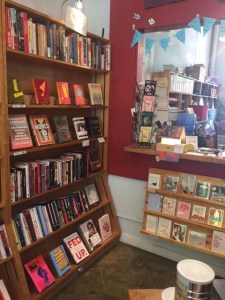
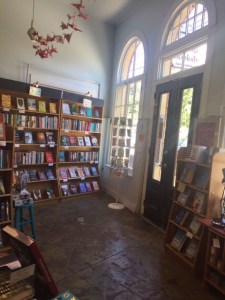
There’s something about Avid Bookshop that makes me think of a charming Britcom. Standing in the quaint, historical building on Athens’ historical Prince Avenue, among rows of artfully placed books, the mid-day sun streaming brightly through the rounded windows, I half expect a blustering, quirky neighbor with a posh-but-flustered lilt to come barreling in, amid a flood of papers and manuscripts, the door slamming a little too hard behind him. He’ll take up residence in one of the corners, at home among the card-stock prints, magnets and coffee, and begin banging on the vintage typewriter, writing a whodunit to rival Agatha Christie, only popping up his head now and again to say something clever and a little biting, followed by a polite, clipped laugh track.

I have no idea where this fantasy comes from. In actuality, Avid Bookshop, located at 493 Prince Avenue, Athens, GA, just down the way from the infamous Daily Co-Op, and right beside historic Fire Hall #2, is as uniquely Southern as it gets. The bookstore, just shy of a decade old, is one of our storied town’s most beloved local businesses. With its loyal fanbase of dedicated readers and patrons, Avid has enjoyed immense success over the years; so much so, they opened a second location in popular Five Points a few years ago to meet customer demand. 

Avid Bookshop opened the Prince Avenue store – its first, original location – in 2011. The business, buoyed by the vision of owner Janet Geddis (and in part, crowdfunded by locals who thirsted for another indie bookstore, after the sad demise of everyone’s favorite newstand, Barnett’s, in 2008), started out small, with just seven shelves. Housed in the former Athens Fire Station, the store and it’s event room next door (tied into the Athens Heritage Foundation) still has the open, airy energy of it’s historical past – the building itself seems to almost beckon, to say, “come in.”  

Fire Hall #2 was built in 1901, and the polished, pleasantly-creaking wood floors and large, open windows tell the tale of a time gone by. According to a smiling employee, “you can almost still smell the firehouse,” which, for me, conjured up the smell of motor oil, rumbling engines, and cigar smoke (that’s just the writer in me projecting; I honestly have no idea what a firehouse smells like). The building was also briefly home to a hair salon, but it wasn’t until Avid moved in that the building once again came into its own. It didn’t take long for Avid Bookshop to take off running; with it’s artistic, creative local flair, emphasis on supporting fellow local businesses, and support of local authors and artists, Avid quickly gained a huge following. With readers and industry professionals alike beginning to sour on huge retail outlets like Amazon and Walmart, Avid easily stepped in to deliver what customers yearned for: a quirky local store with amazing books and engagement with the local scene. While I was there, snapping photos, several customers came in to browse, each of them greeted warmly, most of them greeted by name.

In addition to peddling books – bestsellers, children’s books, local literature and everything in between – Avid sells writing accessories, greeting cards, art, coffee and more. They host a wide variety of events every single week: book signings and launches for local authors (as well as notable celebrity authors such as David Sedaris and Chelsea Clinton, to name a couple); storytime and other child-friendly events (they recently took part in a nationwide Where’s Waldo event); the store also takes part in socially conscious activities, events and movements – they are active in local Pride events, Bookstores Without Borders, and more. I once accompanied my son to a huge Pokemon Go event at Avid; he had a ball searching for illusive Poke-whatevers while I thumbed through a David Bowie-themed coloring book that I’m 100% certain I never would have found at any other bookstore. For that alone, they get an A+ in my book!

Avid Bookshop’s Five Points location

The store’s Five Points location – which, built in the 1920s, enjoys its own historical legacy and clientele – is located at 1662 Lumpkin Street, Athens, GA, right beside Condor Chocolates (do go and have a latte and a cloud boulder after you buy your books). The Five Points store boasts a wider selection of genre-based literature, including larger Sci-Fi/Fantasy, Historical and Romance sections. I was pleased to discover this, as so many indie bookstores (rightly) face criticism for not considering Romance a legitimate genre. There’s also an amazing kids’ section, complete with a huge wooden boat with twinkling electric-blue lights that my son immediately set up as his second home (seriously, I had to force him to leave). It’s a homey space, the sturdy old building clean and every bit as inviting as the signature vintage typewriters that grace both locations. I’m still picturing that silly, charming neighbor pecking away at the keys, writing the Next Great Novel.

Monarchs Under the Sassafras Tree by Lillah Lawson, a Regal House Publishing title
to be released September 20, 2019

The employees at Avid – all of them friendly and eager to please – are approachable and knowledgeable. They are always on hand to recommend their favorite novels to you, to participate in the myriad events that Avid hosts, and talk up the great reads that grace their shelves. When I went into Avid last week to take photos for this article, I was greeted with a wide smile. “You wrote Monarchs Under the Sassafras Tree! I loved that book!” Reader, I must confess that made my day. Not to sound trite, but the staff at Avid love their store, love their job, love the books, and it shows. Just a cursory glance at their glossy, inviting Instagram page will prove it. It’s a haven, a book-lovers paradise.

When I got my publishing deal, and I began to think about things like book launches and signings, Avid was my first choice – I knew that my very first signing for my debut novel would have to be here. There simply was no other option. As a life-long Georgian, born and raised just outside of Athens, local culture is hugely important to me, and those reciprocal relationships between local indie businesses and their clientele are the lifeblood of creatives and business owners alike. There’s something about loving your home, sharing that love by supporting its art and the artists behind it, and championing the entrepreneurs that make it possible. In the era of the chain-store, and shopping with a click, it can be hard for local businesses to stay afloat, especially when many of these large retail outlets undercut so extensively. It’s hard out there; and we all know that not everyone can afford to always shop local. But when you can, do. Just that bit of support can make all the difference in helping a local business thrive. Plus, it just makes you feel good.

As I was outside, cursing myself for trying to take a photo of a shopfront in the midday sun (the worst light ever), it occurred to me that my own O.T. Lawrence and Sivvy Hargrove might have passed by this historic shopfront in their old beat-up truck, on their way back to Five Forks, Georgia. It’s the type of building O.T. Lawrence would appreciate – beautiful without being boastful; sturdy and built to last.

Living in Athens means being spoiled for choice when it comes to historical buildings and cool places to visit. From the old Farmer’s Hardware building to the “R.E.M” steeple; from the beloved Georgia Theatre that rose from the ashes to the celebrated Morton Theatre where I once saw Alice Walker speak; from the double-barreled cannon to the Tree that Owns Itself – any tourist would find a lot to marvel over. I humbly suggest popping into Avid Bookshop the next time you’re exploring our town. The books are the main draw, of course, but the atmosphere of the place alone makes it well worth the visit, and the main reason why Avid is named among the “Best of Athens” almost every year. I’ve been a patron of Avid’s for years, and I’m super proud that next month, I’ll not only be a customer, but an author whose book graces their storied shelves.

Check out Avid online to peruse their selection, buy a book, or to find out more about my signing and other local events, at www.avidbookshop.com. You can also find out more about the shop and their upcoming events on Avid’s Facebook Page (Facebook.com/AvidBookshop).


Join Lillah Lawson at Avid Bookshop in Athens, GA, for the launch event of her lush work of historical fiction, Monarchs Under the Sassafras Tree, that has been hailed as “a love letter to the resilient people of Georgia.” We encourage you to purchase a copy of the book from Avid Bookshop (help support indie bookstores!) and get it signed by the author!

Lillah Lawson lives in North Georgia—not far from Five Forks—with her husband and son, a silly dog and two slightly evil cats. When she’s not writing, you can find her baking, playing bass, marathoning ’80s sitcoms, or out on her bike. She is currently working on another historical
fiction novel, set in the late 1960s.

Filed Under: Book Bound, Regal House Titles Tagged With: Avid Bookshop, BookBound, Lillah Lawson

How the Stories Began…

August 14, 2019 Leave a Comment

Every time I visited Ireland, my father would ask, ‘What kind of rent are ye paying over there?’ I would admit that Paris rents were high – even then, ours was what would soon be called a thousand euros. But we loved it.

My father’s questions may have eventually influenced the decision we made, shortly before the millennium, to buy a place. There were still some bargains to be found in Paris. We soon found a small apartment, applied for a loan, and waited. In a parallel move, using a small sum supplied by my dear and now departed parents, I bought a smaller place I hoped to use for writing. Writing was all I ever wanted to do, but there was never enough time, or a place for it.

We gave notice on our rental, a lovely place near Bastille with marble fireplaces, parquet floors and ceiling moldings. It was one room too small. The owner promptly put it up for sale, having paid too much for it some years earlier during a kind of boom. She had been very fair and easy to deal with, so when her estate agent announced he was bringing a client to visit, I pulled out all the stops.

The agent and the client visited one evening after dark. I had the lamps lit, Mozart piano in the background. The client told the agent he wanted to buy it. Now there was no going back. We waited for news of the loan. And waited. After what already seemed too long a time, I started harassing the bank. My husband’s work schedule didn’t allow him to hang onto the phone for an hour during the day. Anyway, he was too nice to harass anyone. My teaching schedule was more varied. I finally rustled up suitable interlocutors at the bank. At first hesitant, they finally suggested I call the insurance company dealing with the loan. Again, there was a lot of delay. I sensed kerfuffle and kept digging. The purchase of the writing studio went ahead.

I finally managed to wiggle it out of the insurance: my husband was unacceptable for a loan application, because he’d had stomach cancer. The cancer had been removed some months earlier, along with 4/5 of his stomach (that was when we learned that the digestive system is ‘outside the body’ – think about it). He hadn’t received treatment because he hadn’t needed it. His oncologist’s report, which we’d supplied to the bank and the insurance, contained one magical word: CURED.

Back in those days this wasn’t enough for the insurance. They refused the loan (they’re no longer allowed to refuse a loan in France on those grounds). Our rental lease came to an end. We packed up our stuff and got a removal company to drive it all to my new writing space, which luckily had a kitchenette and a tiny bathroom.

A Parisian siesta

There was torrential Parisian rain the day we drove past the hospital in the removal truck, and eased into the narrow street to our new abode. Everything looked sad and run-down in the rain. Some buildings were in bad condition and would later be evacuated by the city before restoration. The removal guys worried for us. All the things that had seemed attractive and even romantic when I’d found a suitable – and cheap – place to write, especially on a sunny afternoon (narguileh parlors, Chinese herbalists, a broad variety of foreign food and music places) seemed to them doubtful.

That night, our boxes piled to the ceiling, we lay in the only flat space left on the floor. The move began to look like a terrible mistake. My gentle husband felt it was his fault. In fact, it turned out to be the best thing that ever happened. We were about to discover, only a short walk from central Paris and its tourist hotspots, a universe teeming with immigrants of all stripes with their problems and the exacerbation of these by French habits and rules – or their own misunderstanding of these.

It was an amazing revelation and a life-enriching experience. I was paying attention to a new place, where our own dilemma, and my status as another immigrant, drew me to relate better to those of my new neighbors and friends. I’d had some success with a few early short stories when living in Morocco. Now, more stories were inspired in that Paris quarter, and Plugging the Causal Breach was born. 

Mary Byrne graduated in English and Philosophy from University College Dublin. She has been a scientific and academic editor, French-English translator and English teacher in Ireland, England, Germany, Morocco and France. She now lives in Montpellier, and loves philosophy, art, and anything baroque.

Filed Under: Author Interview, Regal Authors, Regal House Titles Tagged With: France, Mary Byrne, Plugging the Causal Breach, short story collections

On Writing: Karol Hoeffner’s Notes from Budapest

June 3, 2019 Leave a Comment

I just returned from a month-long working vacation to teach screenwriting workshops in Hungary at the Budapest Film Academy. My family, friends, and colleagues were tucked away in their busy lives, so I traveled solo back to the city where I worked for four months in the fall of 2017. I immediately recognized the ornate art-deco door to the courtyard of my old apartment from the backseat of my cab. I even remembered which of the multiple keys belonged to the four locks on my gated door and how you had to turn the key counter-clockwise twice to unlock it.

I unpacked one suitcase and, slightly jet-lagged, ventured out to my favorite grocer for supplies:  water and yogurt.  The street where I once lived basked in the hazy light of late afternoon. I passed a tiny tot on a scooter followed by her bear of a father, gently guiding her past the street cafes. I breathed in the familiar smell of cigarettes wafting my way. I listened to the cacophonous refrain of a language I neither speak nor understand. 

And halfway down the block, I literally ran into a former Hungarian student strolling toward me.  He hugged me and said, “Karol, I was just thinking about you.”

I was back in my Hungarian hood experiencing the exhilaration of being in a foreign city that no longer feels foreign. After a good night’s sleep, I ambled down half-empty side-streets to the Central Market, a once cavernous train station that was now a bustling farmer’s market. Later, I was swept up by crowds on a busy boulevard leading to the Danube. And remembered how much faster Europeans walk than Californians! The pace in Budapest brings to mind a high-speed autobahn, while strolling in Los Angeles more closely resembles the steady slog of the 405 Freeway during rush hour.

I developed a theory that explains the difference, and stick with me, because in that theory resides a moral lesson for writers. Throughout the morning, I passed hundreds of people.  But I did not see one person talking or texting on their cell.  Not one.When I boarded a crowded tram at Kalvin ter for the square at St. Stephen’s Cathedral, I did note two tourists on their cells. But the locals were gazing out the window, lost in the sweep of city scape.

I wondered if Hungarians pocket their cells because of the distances they travel on foot; maybe they want to keep their hands free for cigarettes or street food – my personal favorite being langos, warm fried bread bubbling with cheese. In Los Angeles, the farthest we walk is from a parked car to our destination. We cross streets, heads down, cell phones in hand, checking messages, Instagram, and funny cat videos.  Because we can’t bear the thought of missing anything.

And in doing so, we miss everything.

The inner working of a writer’s life is defined by the interplay between experience and writing.  But the backbone of experience begins with noticing.  I decided to put my cell away for the rest of the trip. That night, I had an Aperol spritz at the tiny café next door and eavesdropped on a conversation by three expats.  I pretended to be writing in my journal; instead, I wrote down what they said. Among their more memorable comments were the following two:

“In Scotland, God is harsh.”

“My five-year-old niece said that Daddy’s most senior but mommy’s in charge.”

I have no idea where those lines will lead or what they will unlock, but they are worth noting. Since most of my overheard conversations were in Hungarian, I began to focus not on what people said, but how they behaved. And suddenly, standing in lines no longer felt annoying; eating alone no longer seemed lonely.  Both were opportunities to observe life I might miss if I was scrolling through my emails.

I amused myself by making up stories about the people I saw, like the woman in a half-empty restaurant who left her four friends at the bar to answer her cell.  She crouched on a footstool near the door, her head bowed, her brow furrowed. She spoke in forceful staccato beats. I surmised she was either breaking up with a bad boyfriend or plotting the demise of a mortal enemy.  I also considered that she might be in real estate and closing a deal.

But the point is when we cannot participate in language, our sensory awareness heightens. I found it so much easier to journal in Europe, not because I had more time. But because I had noticed more during the day and therefore had more to write about at night.

What marks us as writers is that we are a noticers of life. We are born observers. We are expert spies, listening in on other’s people’s lives.  We not only pay attention to details, we wallow in them. But if we walk through life glued to our cell, we’re not in the world. And if we’re not in the world, we miss out on the stories that surround us in plain sight. So, as writers, let’s stow our cells. Ignore the pings. And aspire to become chroniclers of life because we took the time to notice the details.

Karol Hoeffner is the Chair of Screenwriting at Loyola Marymount University in Los Angeles. She has fourteen film credits including several Danielle Steel adaptations, a television mini-series Harem, movies-of-the-week based on true stories – TheMaking of a Hollywood Madam and Miss America:  Behind the Crown. Among her other credits are the original movies, Voices from Within and Burning Rage. She has penned two young adult novels, All You’ve Got, and Surf Ed.

Filed Under: Regal Authors, Regal House Titles Tagged With: Karol Hoeffner, writing craft

  • « Go to Previous Page
  • Page 1
  • Page 2
  • Page 3
  • Page 4
  • Page 5
  • Page 6
  • Go to Next Page »

Footer

The Regal House Enterprise

Regal House Publishing is the parent company to the following imprints:

Fitzroy Books publishing finely crafted MG, YA and NA fiction.

Pact Press publishing finely crafted anthologies and full-length works that focus upon issues such as diversity, immigration, racism and discrimination.

The Regal House Initiative, a 501(c)(3) nonprofit that conducts project-based literacy and educational outreach in support of underserved communities.

From our Blog

Elliott Bay Book Company

Elliott Bay Book Company: Choosing People Over Platforms

That’s My Story: Scott Lambridis

Books Inc.: Choosing Survival

  • Facebook
  • Twitter
  • LinkedIn
  • Google +
  • Email
Regal House Publishing · © 2017–2026 · Website design by Lafayette & Greene

Loading Comments...