• Skip to primary navigation
  • Skip to main content
  • Skip to footer

Regal House Publishing

Advancing Finely Crafted Literature

  • Home
  • About Us
    • The Origin Narrative of an Indie Press
    • The Regal Mandate
    • Our Imprints
    • The Regal House Initiative
    • Regal House Publishing Staff
    • Our Professional Affiliations
    • RHP’s Climate Commitment
    • Helen Keller Intl
    • RHP Summer Scholars Program
    • Contact & FAQ
    • Blog
  • Authors
    • Our Authors
      • Regal House Authors & Poets
      • Fitzroy Books Authors & Poets
      • Pact Press Authors & Poets
    • Forthcoming Publications
    • Sour Mash: RHP’s Southern Literature Series
    • Fugere Books: RHP’s Novella Series
    • Regal House Reading Series
    • Author Resources
  • Submissions
  • Marketing & Distribution
    • Our Distribution and Printing Partners
    • Subsidiary Rights
    • For Retailers
    • Events
    • A Conspiracy of Lemurs Podcast
  • Contests
    • The Fugere Book Prize for Finely Crafted Novellas
    • The Petrichor Prize for Finely Crafted Fiction
    • The W.S. Porter Prize for Short Story Collections
    • Past Contests
      • The Kraken Book Prize for Middle-Grade Fiction
      • The Acheven Book Prize for Young Adult Fiction
    • The Terry J. Cox Poetry Award
  • SHOP

Blog

The Book Cellar: A Chicago Literary Haven Since 2004

February 23, 2021 Leave a Comment

By Alex Poppe

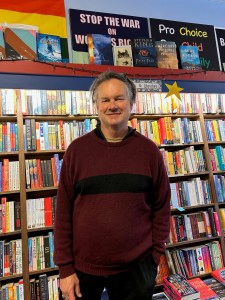
When I asked Suzy Takacs, the owner of Lincoln Square’s The Book Cellar, an independent bookstore on Chicago’s northwest side, what TV series would use her space as a recurring location, she didn’t hesitate with her one-word answer: Cheers. After sitting down to talk with her, it is easy to see why. In our pre-Covid-19 days, not only did this beloved neighborhood fixture serve up some of the best wines by the glass and small plates in the city to accompany its exceptionally well-curated book collection, but more important, it was a home away from home for many of its clients. In fact, when one customer’s son ran away from home, he ran to The Book Cellar, where his mom waited for him to cool down under the staff’s watchful, caring eye.

Another regular used The Book Cellar as a refuge when got locked out of his own home. Older clients who have moved out of the neighborhood to enter assisted living facilities have had their children bring them to The Book Cellar when their children came to visit. One long time regular had the unofficial job of turning the OPEN sign on when he came in. But perhaps the biggest testament to the importance of The Book Cellar in the local community is the $40,000 fans donated through a GoFundMe page last April to help The Book Cellar stay afloat while many businesses in the city capsized due to Covid-19. I asked Suzy what her secret was for inspiring such loyalty. She credited hard work, participating in the local chamber of commerce and in schools, and her commitment to the community, but I have another idea. I think the secret weapon is Suzy. Here’s why.

Suzy wants The Book Cellar to convey a “homey, cozy feel.” She accomplishes this by treating people as if they are coming to her home when they come to her store. She explained that the customer’s experience is personal for her, meaning if someone has a bad experience, she takes it personally. Her concern for the personal, Susy’s heart, is why The Book Cellar is a singular space, a gathering place, a place for conversation, and why it has been with us since 2004. No wonder The Book Cellar team dropped a customer’s purchase off to the customer when pick-up hours conflicted with the customer’s work schedule.

Suzy’s heart extends to her staff. My mouth fell open when she told me she had been practicing appointment only shopping because her staff didn’t feel comfortable with public browsing when Chicago’s positivity rates were above 9%. I was so impressed that her concern for her staff’s and their families’ well-being is more important to her than making money. That is true leadership.

The Book Cellar, 4736 N Lincoln Ave, Chicago, IL 60625

https://www.bookcellarinc.com/

Alex Poppe is the author of Girl, World, which was named a 35 Over 35 Debut Book Award winner, First Horizon Award finalist, Montaigne Medal finalist, was short-listed for the Eric Hoffer Grand Prize, was awarded an Honorable Mention in General Fiction from the Eric Hoffer Awards and was recommended by the US Review of Books. Alex’s novella Duende will be published by Regal House Publishing in the summer of 2022.

Filed Under: Book Bound Tagged With: Alex Poppe, BookBound, The Book Cellar

My line to writing was not a straight one

February 17, 2021 4 Comments

By Lisa Cupolo, winner of the 2020 W.S. Porter Prize for Short Story Collections

I was not a voracious reader from childhood, nor did I come from a bookish or scholarly family. I wandered in creative circles and it took ages for me to uncork my truth, that I wanted to write.  Winning the prestigious 2020 W.S. Porter Prize for short story collections was nothing short of thrilling, and a happy confirmation that I had finally arrived at the right place.

As it turned out, my gateway to writing began when I was thirty-one, and working as a server at the River Café in Calgary. I love to tell this story as a tale of assurance, that your destiny will indeed find you.  I was figuring out my next move, having returned from a year volunteering at an orphanage in Kisumu, near the border of Uganda. My friends were all established in their lives, buying houses and getting married and I was waiting tables and writing scripts with my roommate. I desperately wanted to get into publishing but felt that the bloom was definitely off my rose and that I was too old to start from scratch.

One night, I had a large table of middle-aged businessmen speaking Latin languages, the kind of men who snapped their fingers at me and ordered things like Kir Royale and Negronis. Luckily, I speak French and could just about handle their rudeness. But I noticed that one man stood out, he was kindly and younger than the rest, and he was buying $600 bottles of wine for the table. It became clear that this smiling man was in charge. He was the big cheese.

Pillars of Faith Orphanage in Kisumu

When I decanted another bottle of our cellar’s finest red, the kindly man touched my arm while I poured. “Listen,” he said, in his perfect Parisian accent, “I’m just a small town Canadian boy.” He looked me in the eye; he was flirting.

“I’m from Niagara Falls,” he said.

“Quoi?” I shrieked. “Qui êtes-vous?”  I couldn’t believe it. Call it divine timing, but I also come from that strange and wonderful tourist town. I recognized his surname; his mother had been an alderman when I was a kid.

When I told him my name, he jumped out of his seat. “Is your father Jerry Cupolo?”  Yes, I said. My parents owned the mom-and-pop sporting goods store in our small city. “I idolized your dad,” he said, “Your father gave me my first break. He loaned me a bike to start my own business.”

For the next hour, the two of us sat at a tiny table, captivated by the coincidence, and how many people we knew in common, much to the dismay of his snooty colleagues and the floor manager of the restaurant, who was steaming. At the end of the night the gentle hometown boy left me a $900 tip.  Yowza. That was very near the amount of money for a six-week publishing course in Vancouver that I thought I couldn’t afford. I quit that night, and signed up for the course.  Probably I would have been fired anyway.

Sometimes it’s hard not to believe that the universe is conspiring in your favor, as Paulo Coelho, famously said. One thing leads to another.  I was offered an entry level job at HarperCollins from a teacher at the course, and in March I drove across freezing cold Canada to take an entry level job at one of the big five publishers in Toronto.

In the past, I had worked as an editor in corporate photography and I’d just returned from that year in Kenya so I was hardly a wallflower when I started at HarperCollins. And yet.  I gophered for the vice president, who sent me home with stacks of books on weekends assuring me of a quiz on Monday morning.  He also sent me to Starbucks and to get his wife a Christmas present, and he pawned me off to the president to fetch his A&W root beer and burger every Friday lunch. 

Working as a publicist at Brick Magazine

My big secret, of course, was that once I got into publishing I had to acknowledge that I’d been writing for years. Why else put in the exhausting hours and take on the patriarchal bullshit. First, I loved being around books and writers, and second, I needed a job to survive.  I would begin writing at 5am every morning and then catch the subway downtown for work by 8. I barely covered my rent and subway fare with my take home wage and I was expected to eat and sleep publishing, which I did. It was an exhilarating time and I ended up working as a publicist with many of my favorite writers, Elmore Leonard, Neil Gaiman, Helen Humphries, Ann Patchett and many more.

Still, when my students ask me if going into publishing is a good transition to being a writer, I say no, absolutely not. I’ll never speak to you again if you do it.

But then, I smile.

With an MFA in fiction from the University of Memphis, Lisa’s stories have been published in Ploughshares, the Virginia Quarterly Review, Narrative, The Idaho Review, and others. She has been nominated for a Pushcart Prize and was a Tennessee Williams Scholar at the Sewanee Writers Conference.  She now lives in Southern California and is at work on a memoir. She teaches creative writing at Chapman University.

Filed Under: Regal Authors Tagged With: Lisa Cupolo, short story collections, W.S. Porter Prize winner

Mark Cladis: That’s My Story

January 2, 2021 2 Comments

Regal House staff are delighted to have the opportunity for a virtual sit-down with Mark Cladis in advance of the release of his book In Search of a Course, available in bookstores January 8, 2021.

How did you handle the balance between truth and ‘doing no harm’?  

In Search of a Course is about finding a course for your life and a course for “the University.” The two courses interweave on almost every page of the book. In my search for a course for my life, I recount my failed marriage, my loss of faith in things spiritual and academic, and the strength of a friendship that got me through it all. Finding a course for the University entails a narration about how I got into academia, what it’s like to work in a university, and, most importantly, what higher education is all about—and what it should be.

Given the subject matter of the book—the failure of a marriage and, to some extent, of higher education—you can imagine how it could be a tell-all book, revealing scandalous secrets about my marriage and about life inside the University. I’d probably sell more copies it were a tell-all book, but sadly it isn’t. Indeed, more than one editor pushed me to reveal more personal truths. Where I wanted to stick with general, abstract reflection I was told to offer more of myself and of the people in my life. And so the book evolved, it changed, it became more personal, and I found the need to keep asking myself, “How do I write a personal, honest narrative while doing no harm to those I’m portraying?” After all, I’m writing (in part) about an ex-spouse and University colleagues. What to tell, what to hold back?

In the end, I fashioned a narrative that was honest and intimate but not wounding or gratuitous. Complexities and limitations of the main characters are revealed, but especially my own.

What social issue or problem does your work address? What difference do you hope your book will make?

As noted above, In Search of a Course is about two, related courses: a course for your life and a course for the University. The “problems” or “issues” that my book addresses are both public and private in nature. On the one hand, I address what it is to have the ground beneath you give away in an instant, such that you suddenly lose all sense of who you are, what’s important to you, and what can sustain you in an onslaught of chaos. That’s the private side of the book. The public side addresses such issues as what education is really all about, and how can education, broadly understood, address anomic lifestyles, destructive consumerism, and the toll of a rapacious economy on the social and natural world. And as the two courses are related, so are the public and private problems and the ways forward—ways to greater public and private flourishing. My hope is that readers will see themselves in the pages of the book, find some solace in that identification, and discover helpful, practical reflections as they forge their own paths to meaningful lives.

How did you work to avoid writing a book or characters that feel “preachy” or self-righteous?

I’ll skip this question and take the next one, please. What’s that? I need to answer this one? Well, OK.

I’m a professor. My job is to profess. I can’t afford to worry too much about being sententious. (Did I just say sententious? Perhaps I should worry more about sounding pompous and moralizing.)  I’m certainly more comfortable with being “preachy” (to advocate for something of fundamental importance) than with being “self-righteous” (to be complacent and smug in my own moral standing). In Search of a Course, almost by definition, “professes” and “advocates” insofar as it seeks to help people on their way—their way to greater self-knowledge and joy. But it is an honest narrative. The characters—mainly myself—have more than enough flaws revealed to defeat any moral smugness.

But is it preachy? I’ll have to let my readers answer that.

What was your process like writing In Search of a Course?

The “process”—if it can be called that—was a long, rambling, fractured journey that kept pulling me along. I first starting writing In Search of a Course as a form of therapy. I was emotionally and spiritually crushed. I was writing for myself, and myself alone. Then, my friend Paul Kane and I went on an adventure—a road trip. We were searching for material, teachers, and life for a new course we wanted to teach at Vassar College—”It’s Only Natural: Contemplation in the American Landscape.” So we traveled through landscapes, met extraordinary teachers (including Native American teachers and the land itself), confronted various obstacles, and dipped into some contemplative practices. And as we journeyed through the deserts of the Southwest, I started to come back to life—both personally and professionally as an educator. I was making contact with the social and natural world around me.

Paul Kane, Mark’s friend and travel companion

That’s when the writing changed. I was no longer writing just for me. I imagined writing for a broader audience. My friends. My students. Strangers. All those seeking contact with life—a life with purpose and love.

There was a problem, however. I was soon to be hired by Brown University to rejuvenate a doctoral program in philosophy and religion that had been decimated by several faculty retirements. Brown was bringing me in to rebuild the program. Would it be prudent to craft and publish a trade book for a general audience at the very same time that I was trying to signal to the academic world that Brown is committed to relaunching a “serious”—that is, rigorous, academically acclaimed—doctoral program? Publishing a trade book can ruin a professor’s reputation. What would that do to the reputation of the new doctoral program?

 So I waited. And waited. After about 15 years I decided: to hell with reputation.

Mark Cladis is the Brooke Russell Astor Professor of the Humanities and Chair of his department at Brown University. He was named a Carnegie Scholar and has received research awards from the Fulbright Foundation, the National Endowments for the Humanities, and the Rockefeller Foundation. Cladis lives in Barrington, Rhode Island, with his wife, Mina, and his three children, Sabine, Olive, and Luke.

Filed Under: Author Interview, Pact Press Titles, That's My Story Tagged With: In Search of a Course, Mark Cladis, That's My Story

Kat Meads: That’s My Story

December 4, 2020 Leave a Comment

On the release of Kat’s new work, Dear DeeDee, we were delighted to have a virtual sit down with her to discuss her writing process.

Who has supported you/your writing along the way?

I’ve been lucky. Over the years, I’ve had boosts and buck-ups from many folks. I’m especially grateful for a phenomenal group of women who, in the early going, helped me enormously in terms of support, inspiration and craft. We connected through UNCG’s MFA program and got together outside of class in each other’s houses for evenings of wine, food and rigorous, in-depth critiquing sessions. We called ourselves “Ladies Lit” for multiple reasons, one being, within our group, we treated what others dismissed as “women stories”—meaning stories that prioritized women characters and sensibilities—as serious, worthy fiction. In that group, I was very fortunate to learn from, among others, Lynne Barrett, Candy Flynt and Lee Zacharias. Still learning from their work today—but, alas, we’re too spread about the country to continue those great get-togethers on a regular basis.

How do you research your work?

Researching St. Petersburg

For historical fiction, I start by reading: history, cultural studies, biographies and autobiographies connected to the period and specific events. After that, I try mightily to visit the terrain. For my novel For You, Madam Lenin (Livingston Press/University of West Alabama) I managed to get to Russia. Despite the vast number of years between when I gazed upon the Neva River and my character Nadya Krupskaya did likewise, it was important to my process to experience St. Petersburg, her city—its air and light and atmosphere. My approach is similar when writing nonfiction. Although I’d finished the background research for an Estelle Faulkner essay published in “Full Stop,” before writing the piece, I badly wanted to lay eyes on Estelle’s Rowan Oak bedroom. And despite its “cleaned up” appearance and the thousands of visitors who’d traipsed through the Faulkners’ one-time home before me, that bedroom viewing was definitely worth the trip. Place—actual landscapes and physical structures—are a key component for me in any genre.

Estelle’s Faulkner’s Rowan Oak bedroom

How do you develop your characters?

Dear DeeDee

One of the reasons I was intrigued to try the epistolary form in Dear DeeDee directly relates to that question. How to exclusively address one specific recipient, reveal my own narrator self, and simultaneously have that “private” communication be universal enough in reach and content to interest an unrelated third party? That was the challenge. Eventually I settled on the “huh?” test. Whenever I wigged off on something too insular—a family tidbit that required knowing the entire backstory of all involved to appreciate its significance—that passage failed the huh? test and got nixed. For fiction, typically, I start with a visual of the character, then fast forward to the question: What’s troubling this character? That one-two usually dumps me into a narrative thicket fairly quickly. In Dear DeeDee, what’s troubling Aunt K is a bundle of stuff: time passing, where (now) to call home, were the life choices she’s made right or wrong or just inevitable—those kinds of probes. Fundamentally, it’s a book about identity, questions of identity.

What are the nuances differentiating memoir and autobiography?

I’m partial to Gore Vidal’s interpretation of those terms: autobiography requires fact checking; memoir is how one remembers one’s life. And “memoir,” Vidal went on to say, “is apt to get right what matters most.” It’s been my experience that I often discover “what matters most” during the writing process. You’d think I’d know beforehand—and sometimes do—but very often I find it’s the writing out that clarifies and confirms what’s what for me.

Where/when do you get your best writing ideas?

Cleaning house. I have no idea why—but there it is. Dust a lamp, sprint back to the desk, scribble notes; vacuum half a room, sprint back, scribble notes, etc. Needless to say, it takes me longer than it should to clean my house. Even so: side benefits.  

Kat Meads is the award-winning author of 20 books and chapbooks of prose and poetry, including: 2:12 a.m.; Not Waving; For You, Madam Lenin; Little Pockets of Alarm; The Invented Life of Kitty Duncan; Sleep; and a mystery novel written under the pseudonym Z.K. Burrus, set on the Outer Banks. Dear DeeDee, released by Regal House Publishing, is in stores December 4, 2020.

Filed Under: Author Interview, Regal Authors, Regal House Titles, That's My Story Tagged With: Dear DeeDee, Kat Meads, That's My Story

These are a few of my favorite things: Amherst, MA, public libraries

November 9, 2020 Leave a Comment

by Shirley Reva Vernick

The Jones Library

Back when I was checking out towns in which to raise my children, one of the first local stops was always the public library. The Jones Library in Amherst, MA clinched it for me. Nestled in a stately stone building right off the main street, the library bustled with patrons of all ages that day—people reading, learning, enjoying group activities, installing exhibits, and generally creating an energized atmosphere of community. My family moved to town within a few months of that visit.

Originally housed in a local hotel, the 102-year-old Amherst library system now includes the main Jones branch and two satellites to serve the town’s 40,000 residents. Through the years, the library has loaned millions of books and digital media; hosted thousands of meetings, book talks and musical events; and continually applied new technology to the service of patrons. Need to borrow a ukulele, an air quality monitor, a museum pass, or a wireless hotspot? Incredibly, it’s just a library card away.

Literal—and literary—riches

Linda Wentworth, head of adult collections, says she has her dream job at the Jones. “I get to work with a community that’s insane about reading, and I have the privilege of managing a 300,000-item collection, some of it in multiple foreign languages.”

The Jones is now teaming up with another library in town, the national Yiddish Book Center, to (remotely) celebrate Coming to America. With the financial and intellectual support of the Yiddish Book Center, the Jones has arranged a reading group to discuss three books of Yiddish literature in translation, plus a fourth book related to one of Amherst’s larger immigrant communities: the Chinese. 

The discussion series, facilitated by Wentworth, will use these books to explore the ways in which immigrants change our country, and the ways in which our country changes those who immigrate here. Through these discussions, participants will explore the range of immigrant experiences and how these experiences are portrayed in literature. 

Another project on the drawing board is an ongoing book concierge service. Patrons will be invited to specify what kinds of books they like, and the staff will put two relevant selections on hold for them each month. Now, that’s my kind of book-of-the-month club!

Start ’em young

The library’s youth services have enjoyed increased attendance over the last five years, thanks to a trifecta of new children’s programs, the creation of a young-adult librarian position, and a focus on inclusivity.

A captivated audience

“Public libraries used to expect teens to act like adults and use the adult spaces,” notes library director Sharon Sharry. “Now that the Jones has given teens a dedicated space, their own programming, and a specialized librarian, we’ve become a cool place for YAs to hang out.”

The children’s room is continuously finding ways to embrace diversity. For instance, the library used to host an annual American Girl doll party, where girls could bring their American Girl dolls and participate in related activities. “But American Girl dolls are expensive,” says Mia Cabana, youth services director, “and are traditionally only for girls. So now we do a teddy bear/doll tea party, where both boys and girls are welcome, and the toy you bring doesn’t need to be fancy.”

Some children have adopted this party as a way to explore their sexual identity. Whether it’s a boy bringing a doll or a girl dressing up in a bowtie, all are welcome.

Something special

Many times over the years, I’ve lost myself in the library’s special collections. What a treasure—especially, in my opinion, the manuscript collections of local icons Emily Dickinson and Robert Frost. I was so delighted to find a handwritten rough draft of Frost’s “Stopping by Woods on a Snowy Evening,” I was afraid I’d stare the ink right off the page. I’m also partial to the Amherst authors collection, which showcases books and articles written by Amherst residents from 1730 to today. You can find Noah Webster’s lexicographical studies, Robert Francis’s poetry, Norton Juster’s The Phantom Tollbooth (my personal childhood favorite), and much more.

“The special collections allow people to bridge Amherst’s past to its present,” says Cyndi Harbeson, head of special collections. “Whether I’m sharing famous historical manuscripts or tracking the provenance of local buildings, I love working with school children, high school and college students, genealogists, international scholars, and general Amherst residents.”

Harbeson points out that the collections also highlight non-celebrity residents, including “regular” people’s historic photos, scrapbooks, store records, maps and legal deeds. “We serve as a repository for local Cambodian refugees’ records too,” she adds. “My hope is to expand this initiative and make the special collections more representative of our community.”

When we’re apart

Quarantine, unfortunately, has closed the buildings. Nevertheless, the library services persist. The award-winning ESL and citizenship programs have thrived remotely. Dungeons & Dragons tournaments, wee sing-alongs, bilingual story times, tech support for personal computers—all these are thriving virtually, as are author interviews, art instruction, and music lessons.

In addition to keeping its digital materials and research tools available, the Jones has developed an effective protocol for socially distanced book borrowing. The main branch is offering home delivery, as well as weather-dependent outdoor pickup. Meanwhile, the South Amherst branch has taken a page from the “wine windows” that dotted Florence, Italy, during the 17th-century bubonic plague scourge. Wine merchants during that time built tiny windows through which they could pass wine flasks, thus avoiding direct contact with customers. In just this way, the South Amherst branch is passing bagged books to patrons.

Love ya, tomorrow

In 2021, the Jones is hoping to begin a significant building renovation, updating existing structures and adding new space. The library has already been offered a state grant to help support the renovation. Now the staff is awaiting a town council vote on whether to underwrite the balance. “I’m very optimistic,” says Sharry.

The library also plans to rev up its nascent anti-racism movement. “We want every person who crosses our threshold to feel at home,” Sharry says. Indeed, one highly visible example of this initiative greets patrons as soon as they walk through the Jones’ front door. The large painting in the entryway titled “English Nobleman” (often mistaken for Lord Jeffrey Amherst, the man purported to have sent smallpox-infected blankets to Native Americans in the 18th century) has been replaced with a landscape.

Jorge Luis Borges imagined paradise as a kind of library. It seems to me that the Jones is, if not a literal paradise, then certainly a warm and welcoming place for exploration and self-expansion. I can’t wait to be able to pop back in for a browse, and I’m grateful for the staff’s creative and technical expertise that keeps me connected in the meantime.

Shirley Reva Vernick is the author of The Blood Lie, Remembering Dippy, and The Black Butterfly. Her work has garnered innumerable awards and recognition, some of which include: the American Library Association Best Fiction Books for Young Readers List, Simon Wiesenthal Once Upon A World Book Award, Dolly Gray Literature Award from the Council for Exceptional Children, Langum Prize for American Historical Fiction. Fitzroy Books is proud to publish Ripped Away in 2022.

Filed Under: Book Bound Tagged With: BookBound, Shirley Reva Vernick, The Jones Library

Q&A

October 21, 2020 1 Comment

Q&A is a bold new page-turner by M. ALLEN CUNNINGHAM about reality television, big pharma, high-tech distraction, the triumph of incoherence, and deception via screens. Coming January 2021 from Regal House Publishing.

Filed Under: Regal House Titles Tagged With: M. Allen Cunningham, Q&A

How to Start a Novel

September 28, 2020 1 Comment

By Martha Anne Toll

People frequently tell me that they want to write a novel, they just don’t know how to start. Unfortunately, I have no advice, only a few thoughts on how I came to write Three Muses, which has found a wonderful home with Regal House Publishing.

An author is the worst person to describe her novel, but this was my 100-word pitch for Three Muses:

John Curtin, né Janko Stein, finds his way in America—damaged and traumatized—having survived a concentration camp singing for his family’s killer. World famous ballerina, Katya Symanova, née Katherine Sillman, fights her way from a lonely home and an abusive and intense creative partnership with her choreographer. Ultimately, she must face the impossible choice between art and love. How John and Katya find one another and unlock their futures forms the heart of this novel, which is framed against the power of three muses: Song, Discipline, and Memory. 

I know what year I started writing my novel, and I know some of its sources. Most of its origin story remains shrouded, however.

♪ ♪ ♪

In 2010, I was casting around for a frame on which to hang a new story. I stumbled upon a tradition from the Greek island of Boeotia that honored three muses. Song, Discipline, and Memory were said to be the original muses, and, in at least one version, Memory was said to give birth to the nine muses who came down to us through history.

I don’t know ancient Greek, but I was intrigued by the translation of their names: Aoede (song or tune), Melete (discipline and the preparation for prayer), and Mneme (memory). Beyond these translations, I found virtually nothing from the few Greek scholars I consulted, nor from inquiring at the National Archeological Museum in Athens, nor from the internet.

Nevertheless, I couldn’t let go of these three women. What difference did it make that I knew nothing about them? The novelist’s job is to weave fictions.

As I started writing, I came to know my protagonist, John Curtin, who was pulled out of line to sing for the Kommandant at a Nazi concentration camp. Would the Muse of Song abandon John once he reached safety? I began to worry that music would be a lifelong torture for him.

I spent hours at my computer, trying to inhabit the ballet studio with Katya, a woman who lives to dance. Was she working too hard? Too enmeshed with Boris Yanakov, her choreographer?

They haunted me, these characters—John for the agony of his experience and Katya for the consequences of her iron will (Discipline). I watched the Muse of Memory hover over both of them. Memory tends to do that with all of us.

I took in more than a few skeptical comments about the muses. After multiple re-writes, I reached an accommodation with their role in the story. Readers will need to have the final say. It’s up to them to decide what impact the muses have on Katya and John.

♪ ♪ ♪

On the other hand, I wonder if my lifelong passion for ballet was the source of my novel. I adored ballet from my earliest memories of it. At age five, I started taking lessons with Miss Corinne, who wore a bright red leotard.

And yet. I’m not sure that memory is accurate. It could have been my two older sisters who took from Miss Corinne. Maybe I came with my mother to pick them up when lessons were over.

I do remember my later enchantment, waiting for class to begin at the School of the Pennsylvania Ballet in Philadelphia, peering into the window, watching professional dancers rehearse. I would have happily spent all my time in front of that little window. It was an opening to a magical world of hard work and beauty.

Or maybe it was my long years playing viola and studying music. My compulsion to try to get music on the page. My need to explore what became a fraught and painful relationship with my instrument.

Music is backbone to Three Muses—it is the vehicle for Katya to express herself, and for John, the means of survival.

♪ ♪ ♪

Alternatively, it’s true that the inspiration for Three Muses was my feverish interest in the Holocaust. The older I get, the closer the Holocaust feels to my birth. I read and read about it. I listen to people’s harrowing family stories.

The Holocaust is more than a living memory, it was part of my upbringing. I come from a generation who knew Holocaust survivors. They were my relatives with German accents, my friends’ parents, my extended family. They were familiar; they visited our high school classrooms. I played music with them; they were my dentist and later my bosses.

Too, they were blanketed in silence. Like so many in her generation, my Nana avoided talking about them; she declined to discuss “that Nazi business.” My parents acted similarly.

My family was assimilated in the same ways that our German relatives were. We were not religious or observant. We were Americans first, just as our relatives were Germans first.

It was the poison of anti-Semitism that separated Jews from their compatriots, that made entire societies collaborate in their roundups and murder. Now we call it “othering,” the toxic process by which a group of people is made so onerous and reviled that they become non-human, opening the way for oppression and mass slaughter.

Never forget, we Jews say, meaning never repeat, no matter which group of people are the objects of derision. Here in the United States, the president and his henchmen have been relentless in their efforts to other. Their practice is not only cruel and vicious; it is also extremely dangerous. America is in peril. We need stories to help awaken us to hatred’s risks.

♪ ♪ ♪

In the end, I can’t describe the origins of Three Muses. I only know that we humans are angry and loving; we are selfish and injurious and kind.

How to express the trove of unique stories each of us carries around? We can sing and dance; we can remember out loud. Or we can we suppress our traumas and live in freighted silence, hermits sitting atop memories that are too shattering to voice.

I prefer to break the silence.

Martha Anne Toll is the 2020 recipient of the Petrichor Prize for Finely Crafted Fiction. Her novel, Three Muses,is forthcoming from Regal House Publishing in Fall 2022. She is a regular contributor to NPR Books and other outlets; and was the founding executive director of the Butler Family Fund, a social justice philanthropy. 

Filed Under: Regal Authors, Regal House Titles Tagged With: Martha Anne Toll, Petrichor Prize winner, Three Muses

To Pants or to Plot? In Defense of a Middle Way

September 25, 2020 Leave a Comment

By Rebecca Baum

I first encountered the terms pantser and plotter on a writing retreat in New Hampshire on Squam Lake. As dusk gathered and the loons wailed, a writer asked which approach I’d used for the middle grade novel I was working on. She went on to define the plotter as the writer who outlines a beginning, middle and end before the first keystroke of the novel itself; and the pantser as the thrill-seeking, fly-by-the-seat type. All they need is a snippet of a scene, glimpse of a character, or flash of setting — and they’re off!

I confessed to being a pantser. My middle grade book emerged in caffeine-fueled bursts, my outflow hindered only by my too-slow fingers. It was my first novel and the process of discovering the story as it was being written was unbridled fun. The downside (as early readers reported) were moments where the story felt rushed or where plot and character motivation didn’t always jibe. Unsurprisingly, that novel was never published. But it was a valuable exercise in showing up every day to slay the dragon of the empty page until eventually I’d hammered out over 60,000 words.

My novel, Lifelike Creatures, started as a pantser affair but morphed into a plotter-pantser hybrid. I started with a visceral sense of the landscape, lifted from my childhood in Cottonport, La. — fresh, turned earth and muddy fields stretching to the horizon, the stultifying heat of high summer, a gray sky both endless and oppressive. Within this rural setting a girl appeared, 13 years old, most comfortable with her toes in the mud. A boy, perhaps a brother, briefly bobbed into view then disappeared, replaced by the girl’s mother. Soon their relationship took shape, a claustrophobic constellation propelled by addiction, resilience, pain, and fierce love. The girl became “Tara” and the mother became “Joan.”

I brought these green shoots into a writing workshop. Each week, as I worked and reworked a chapter, or even a few pages, the contours of Tara and Joan’s relationship solidified. The details of their home came to life as did the intimacies and tensions of their days. The workshop facilitator challenged me to widen the lens and discover a larger community or cultural conflict against which Tara and her mother could struggle and transform — or falter and fail.

He also encouraged me to write a chapter outline, nudging me into the realm of the plotter.  An early outline, which is very different from the final novel, has Tara losing her way in a salt dome mine during a visit to Avery Island (home of Tabasco Pepper Sauce ). Salt domes are massive underground deposits, some as large as Mount Everest, which feature prominently in Louisiana’s geology. I’ve always found them fascinating and mysterious, an interest I share with Tara:

Before fifth grade, when her class had studied salt domes, she’d pictured the New Orleans Superdome made out of salt, buried a few feet below her front yard. But the teacher had explained that the domes were more like underground mountains, formed when an ancient seabed buckled up over millions of years through the surrounding crush of earth. The salt behaved almost like lava, flowing upwards until it capped near the surface. For a time afterwards, whenever Tara salted her food, she imagined tiny flecks of bizarre prehistoric sea creatures mixed in with it.

–Lifelike Creatures, pg. 36

So the impulse to somehow include salt domes in the story emerged early on, even before I’d plotted the larger conflict that would come crashing into Tara and Joan’s world. With salt domes on my radar, it was inevitable that I should happen upon the other geologic phenomenon of Lifelike Creatures, the one that became the larger conflict — a sinkhole. Turns out the two often go hand-in-hand.

Salt dome cutout, from Louisiana
State Exhibit Museum

Salt domes and sinkholes have made headlines in Louisiana several times over the years, most dramatically at Lake Peignur in 1980, when the drill from an oil rig barge punctured a salt dome beneath the lake. The miscalculation created a sinkhole, triggering an enormous whirlpool that drained the lake and even reversed the flow of a nearby canal, temporarily creating Louisiana’s tallest recorded waterfall.

More recently, the Bayou Corne sinkhole was precipitated by a collapse in the Napoleonville Salt Dome. Or more accurately, the wall of a hollowed out cavern within the dome, near the dome’s outer wall. The cavern was manmade, as are dozens of others nested deep within the dome’s interior. Adding to the mystique of these underground marvels is the fact that they are uniquely well-suited for storing hydrocarbons, natural gas, and even crude oil. If the earth shifts, the salt walls flex and flow. Integrity is maintained as long as the surrounding salt is of adequate thickness. It was not in the case of the Bayou Corne sinkhole. As a result, an entire community was displaced with many residents leaving behind what they’d assumed would be the golden years of retirement.

The Bayou Corne sinkhole

The sinkhole in Lifelike Creatures is modeled on this real-life industrial disaster. My fictionalized version not only connects the “small” story of Tara and Joan with larger, catalytic forces. It also mirrors the downward spiral of drug and alcohol addiction and the corrosive effects on the parent-child relationship. I’m fortunate to have a close friend who is a geologist. He generously shared his expertise, allowing me to plausibly plot sinkhole and remediation events that force Tara and Joan into “adapt or die” situations.

So pantser or plotter? Based on my experience with Lifelike Creatures, I’ve embraced a middle way. The tools of the plotter kept me grounded even as the chapter outline changed and evolved. The pantser’s spontaneity offered unforeseen gifts, including a pivotal moment that totally took me by surprise. Early readers have had no qualms about pacing or character motivation. And Tara and Joan were given what every character deserves — a plot integrated with their core desires and beliefs.

Rebecca Baum is a New York City transplant from rural Louisiana. She’s authored several short stories and two novels. The most recent, Lifelike Creatures, was published by Regal House Publishing on September 17, 2020. She is represented by Jeff Ourvan at Jennifer Lyons Literary Agency. She’s a cofounder of a creative studio where she is a ghostwriter, copywriter, and blogger. She lives in Greenwich Village with her husband and their cat.

Filed Under: Literary Musings, Regal Authors Tagged With: Lifelike Creatures, Rebecca Baum, writing craft

  • « Go to Previous Page
  • Page 1
  • Interim pages omitted …
  • Page 4
  • Page 5
  • Page 6
  • Page 7
  • Page 8
  • Interim pages omitted …
  • Page 13
  • Go to Next Page »

Footer

The Regal House Enterprise

Regal House Publishing is the parent company to the following imprints:

Fitzroy Books publishing finely crafted MG, YA and NA fiction.

Pact Press publishing finely crafted anthologies and full-length works that focus upon issues such as diversity, immigration, racism and discrimination.

The Regal House Initiative, a 501(c)(3) nonprofit that conducts project-based literacy and educational outreach in support of underserved communities.

From our Blog

The Raven Book Store

The Raven Book Store: Literary Bastion of the Enduring Free State Fortress

Dog Eared Books: The Store That Always Has the Right Book

Borderlands Books: The Store Its Readers Refused to Lose

  • Facebook
  • Twitter
  • LinkedIn
  • Google +
  • Email
Regal House Publishing · © 2017–2026 · Website design by Lafayette & Greene

Loading Comments...