
Back when I was checking out towns in which to raise my children, one of the first local stops was always the public library. The Jones Library in Amherst, MA clinched it for me. Nestled in a stately stone building right off the main street, the library bustled with patrons of all ages that day—people reading, learning, enjoying group activities, installing exhibits, and generally creating an energized atmosphere of community. My family moved to town within a few months of that visit.
Originally housed in a local hotel, the 102-year-old Amherst library system now includes the main Jones branch and two satellites to serve the town’s 40,000 residents. Through the years, the library has loaned millions of books and digital media; hosted thousands of meetings, book talks and musical events; and continually applied new technology to the service of patrons. Need to borrow a ukulele, an air quality monitor, a museum pass, or a wireless hotspot? Incredibly, it’s just a library card away.
Literal—and literary—riches
Linda Wentworth, head of adult collections, says she has her dream job at the Jones. “I get to work with a community that’s insane about reading, and I have the privilege of managing a 300,000-item collection, some of it in multiple foreign languages.”
The Jones is now teaming up with another library in town, the national Yiddish Book Center, to (remotely) celebrate Coming to America. With the financial and intellectual support of the Yiddish Book Center, the Jones has arranged a reading group to discuss three books of Yiddish literature in translation, plus a fourth book related to one of Amherst’s larger immigrant communities: the Chinese.
The discussion series, facilitated by Wentworth, will use these books to explore the ways in which immigrants change our country, and the ways in which our country changes those who immigrate here. Through these discussions, participants will explore the range of immigrant experiences and how these experiences are portrayed in literature.
Another project on the drawing board is an ongoing book concierge service. Patrons will be invited to specify what kinds of books they like, and the staff will put two relevant selections on hold for them each month. Now, that’s my kind of book-of-the-month club!
Start ’em young
The library’s youth services have enjoyed increased attendance over the last five years, thanks to a trifecta of new children’s programs, the creation of a young-adult librarian position, and a focus on inclusivity.

“Public libraries used to expect teens to act like adults and use the adult spaces,” notes library director Sharon Sharry. “Now that the Jones has given teens a dedicated space, their own programming, and a specialized librarian, we’ve become a cool place for YAs to hang out.”
The children’s room is continuously finding ways to embrace diversity. For instance, the library used to host an annual American Girl doll party, where girls could bring their American Girl dolls and participate in related activities. “But American Girl dolls are expensive,” says Mia Cabana, youth services director, “and are traditionally only for girls. So now we do a teddy bear/doll tea party, where both boys and girls are welcome, and the toy you bring doesn’t need to be fancy.”
Some children have adopted this party as a way to explore their sexual identity. Whether it’s a boy bringing a doll or a girl dressing up in a bowtie, all are welcome.
Something special
Many times over the years, I’ve lost myself in the library’s special collections. What a treasure—especially, in my opinion, the manuscript collections of local icons Emily Dickinson and Robert Frost. I was so delighted to find a handwritten rough draft of Frost’s “Stopping by Woods on a Snowy Evening,” I was afraid I’d stare the ink right off the page. I’m also partial to the Amherst authors collection, which showcases books and articles written by Amherst residents from 1730 to today. You can find Noah Webster’s lexicographical studies, Robert Francis’s poetry, Norton Juster’s The Phantom Tollbooth (my personal childhood favorite), and much more.
“The special collections allow people to bridge Amherst’s past to its present,” says Cyndi Harbeson, head of special collections. “Whether I’m sharing famous historical manuscripts or tracking the provenance of local buildings, I love working with school children, high school and college students, genealogists, international scholars, and general Amherst residents.”
Harbeson points out that the collections also highlight non-celebrity residents, including “regular” people’s historic photos, scrapbooks, store records, maps and legal deeds. “We serve as a repository for local Cambodian refugees’ records too,” she adds. “My hope is to expand this initiative and make the special collections more representative of our community.”
When we’re apart
Quarantine, unfortunately, has closed the buildings. Nevertheless, the library services persist. The award-winning ESL and citizenship programs have thrived remotely. Dungeons & Dragons tournaments, wee sing-alongs, bilingual story times, tech support for personal computers—all these are thriving virtually, as are author interviews, art instruction, and music lessons.
In addition to keeping its digital materials and research tools available, the Jones has developed an effective protocol for socially distanced book borrowing. The main branch is offering home delivery, as well as weather-dependent outdoor pickup. Meanwhile, the South Amherst branch has taken a page from the “wine windows” that dotted Florence, Italy, during the 17th-century bubonic plague scourge. Wine merchants during that time built tiny windows through which they could pass wine flasks, thus avoiding direct contact with customers. In just this way, the South Amherst branch is passing bagged books to patrons.
Love ya, tomorrow
In 2021, the Jones is hoping to begin a significant building renovation, updating existing structures and adding new space. The library has already been offered a state grant to help support the renovation. Now the staff is awaiting a town council vote on whether to underwrite the balance. “I’m very optimistic,” says Sharry.

The library also plans to rev up its nascent anti-racism movement. “We want every person who crosses our threshold to feel at home,” Sharry says. Indeed, one highly visible example of this initiative greets patrons as soon as they walk through the Jones’ front door. The large painting in the entryway titled “English Nobleman” (often mistaken for Lord Jeffrey Amherst, the man purported to have sent smallpox-infected blankets to Native Americans in the 18th century) has been replaced with a landscape.
Jorge Luis Borges imagined paradise as a kind of library. It seems to me that the Jones is, if not a literal paradise, then certainly a warm and welcoming place for exploration and self-expansion. I can’t wait to be able to pop back in for a browse, and I’m grateful for the staff’s creative and technical expertise that keeps me connected in the meantime.

Shirley Reva Vernick is the author of The Blood Lie, Remembering Dippy, and The Black Butterfly. Her work has garnered innumerable awards and recognition, some of which include: the American Library Association Best Fiction Books for Young Readers List, Simon Wiesenthal Once Upon A World Book Award, Dolly Gray Literature Award from the Council for Exceptional Children, Langum Prize for American Historical Fiction. Fitzroy Books is proud to publish Ripped Away in 2022.


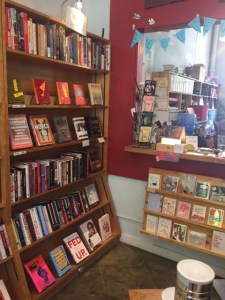


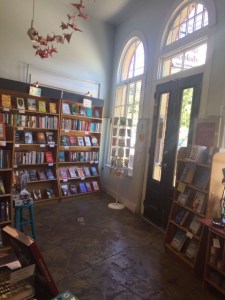

 The modern world provides us with countless conveniences. Almost anything we could want is available for purchase within seconds, at any moment. Amazon can deliver a package to our house within days for free, and this convenience is exemplified by book deliveries, its flagship service. So why then do we still go to book stores to buy books? This simple answer is that we don’t; we go for the experience. The more complicated answer involves our relationship with books and our emotional responses to seeing them, browsing them, the wholly deliberate de-commodification we enact by treating books as something slightly more sacred than most of the other objects we buy. Bookstores evoke a complex web of interconnected desires, sensations, and visceral satisfactions, all of which can be more or less articulated as the smell of books. As services like Amazon out-supply big-name stores like Borders and Barnes & Noble with its unlimited capacity and as sleek e-readers pose as practical upgrades to thousand-page tomes, an independent bookstore like Flyleaf Books continues to thrive because it is an important member of the community for which simple convenience could never substitute.
 The interior almost seems designed to facilitate a sense of discovery and opportunity. After meandering through the front area, browsing the newest releases and staff favorites, the staff-curated poetry section and various fiction and non-fiction sections, you are inevitably drawn towards the back of the store to discover the—again, curated—children’s section. The space is semi-contained by half- and full-sized bookshelves and resembles a play area. To the other side, an entrance opens up into a large, spacious room containing the used books section. This space serves as a reflection of the front, with bookshelves lining the walls and tables set up in the middle. This is also the space where the community engages itself in the events hosted by the store.
 Flyleaf is clearly managed by people who care about what they do. Over the course of interviewing her, Jamie stopped several times to personally make sure that people in the store had help if needed. When speaking about the store, she mentioned that, growing up in Chapel Hill, she had always wanted someone to open up the kind of bookstore Flyleaf has become. One can’t help but think of Toni Morrison’s advice to write the book you want to read; the same can be said of the stores that sell them. It certainly isn’t the largest bookstore in the area, but with its carefully managed selection, that hardly matters. Each section is constantly curated, and Jamie joked that five different people touch each book before it makes it to the shelf. When browsing the selections, that level of care is obvious. Jamie worked to find the right mix of people to help her manage the store and noted how happy she is with the staff group and culture.

 Like so many others, I had moved to New York City with a dream to write, to be at the center of things and pay attention. But such a reality, even in the service of a great dream, is a hard and often lonely one. I knew it wouldn’t be an easy move to make, but I’d be lying if I said it wasn’t harder than I guessed it would be. I was out of my element and struggling to find my place. I knew very few people. To say that I was overwhelmed and scared on a daily basis would be an understatement.
 I had an appointment. I was set to interview

 At this point in our conversation, Carol stopped and looked far off. I followed her line of sight. She was looking out the window, at the streams of autumnal light. Whatever she said next would be carefully considered. She took a deep breath.


 The store-front windows of Broadway Books make the shop light and airy, and its well-organized shelves draw customers on to explore the next book, the next topic, the next table. Over the shelves hang poster-sized covers of other volumes for which readers might want to search.
 The birthday party on Saturday made it obvious what a community asset the store is. I met a trio of women who had been friends for forty years. Regular customers milled about, chatting, talking books with the owners and staff, having their photos taken at the picture booth set up for the day, and eating cake and drinking champagne. Despite the bustle of the celebration, I saw the staff continuously assisting customers by making recommendations and finding books. One of the owners (alas! I did not discover which one) asked everyone there to please go out and tell the story of their book store, and I am happy to comply with that request here.

 I began my bookstore safari in Seattle, Washington, where I was visiting my particular friend Maren Donley. Before I arrived, I explained my quest to her, and she immediately recommended a visit to the Third Place Books. While there are three Third Places (I’m not sure how the math works on that, whether it requires simple addition or some kind of quantum exponential multiplication), Maren suggested we drop by the Lake Forest store. “I drive by it twice a week. I had never been in until I met my priest there for a meeting. Then I said, ‘Oh! I have really been missing out!'” she told me.


 The selection of books, Mr. Sindelar told me, has a curatorial aspect. The staff have a lot of say in the choices, which are also guided by the interests of customers and the diverse ideas and opinions that represent the neighborhood. It seems that every aspect of Third Place is indeed geared toward fostering community and neighborhood. The Commons area not only has ample seating and a play area for small children, it has three restaurants as well: sustenance for both mind and body.
 As we wended our way toward the registers at the front of the store, Maren pointed out the cards that annotated the books on the tables and shelves. The cards offered reviews by the staff, noted awards won by the book and author, and even let browsers know that a less expensive edition of the book in question was available on a different shelf in the store. I had seen cards similarly deployed in other stores, but never to such good effect. Walking through the store while looking at the books and reading the cards was like enjoying a stimulating conversation with friends or taking part in a silent book club discussion.


